Invent@SU

Student Teams Showcase Original Devices at 2025 Invent@SU Final Presentations

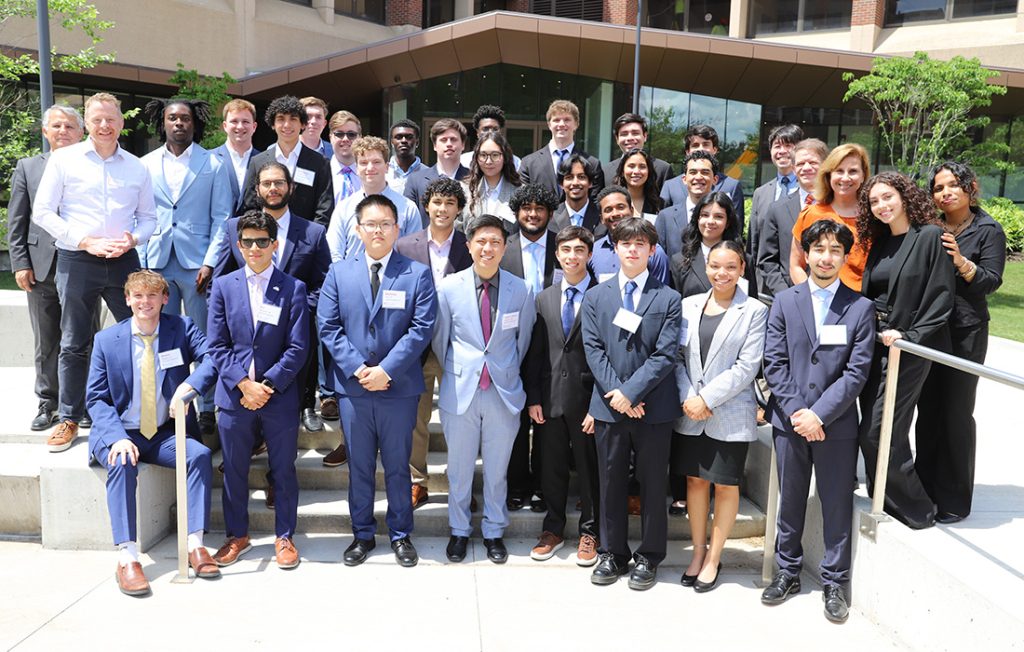
Eight teams of engineering students presented designs for original devices to industry experts and investors at Invent@SU Final Presentations. This six-week summer program allows students to design, prototype, and pitch their inventions to judges. During the program, students learn about ideation and intellectual property and receive weekly feedback from guest evaluators to refine their devices.

On June 18th, the teams gave their final pitch presentations to a panel of expert judges. The audience included Dean Cole Smith and program supporter Mike Lazar. The event kicked off with poster presentations that allowed teams to showcase their inventions and answer questions.

This year’s competitors were: 

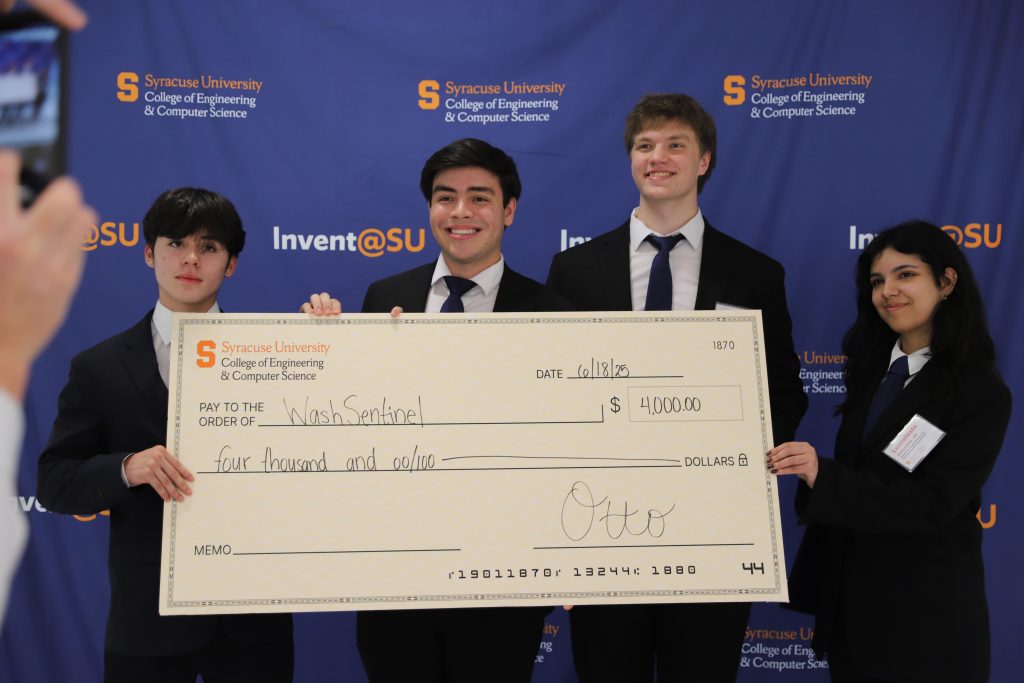
WashSentinel (First place)

Team members: Andy Rivera ’28 (computer science), Luzceleste Delgadillo ’28 (computer science), Mikel Aizpurua ’28 (mechanical engineering), and Peter Slabaugh ’28 (mechanical engineering) 

WashSentinel is a laundry security device that detects unauthorized washer or dryer access, sends phone alerts, and prevents theft with a built-in alarm. 
KidKlamp (Second place)

Team members: Alexis Herveron ’27 (chemical engineering), Darika Djusupova ’28 (computer science), Jared Murtha ’26 (mechanical engineering), and Mark Short ’25 (aerospace engineering) 

KidKlamp offers an easy, accessible way to securely install infant car seat bases with minimal effort, reducing misuse and providing clear feedback for proper installation. 

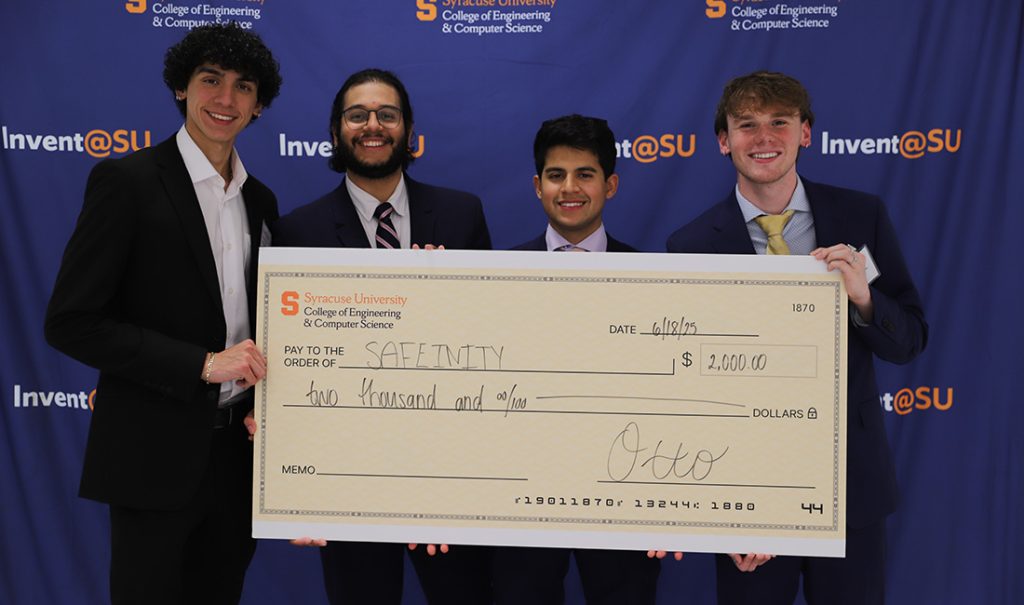
SAFEINITY (Third place)

Team members: Diego Malonado ’27 (computer science), Santiago Sanabria ’26 (mechanical engineering), Ari Spinoza ’28 (electrical engineering), and Owen Wilson ’27 (mechanical engineering) 

SAFEINITY is a discreet wearable that sends emergency alerts with location and user info via Wi-Fi—no smartphone needed—with backup eSIM and Bluetooth for added reliability. 
VentIQ (Fourth place)

Team members: John Carpio ’27 (mechanical engineering), Suraj Parida ’27 (computer engineering), and Joshua Persaud ’27 (computer science) 

VentIQ is an easy-to-attach dryer connector with a built-in manometer that monitors lint buildup.

GripSync

Team members: Gavin Lesk ’27 (mechanical engineering), Barrett Lathrop ’26 (aerospace engineering), and Joshua Edwin Limjuico ’26 (biomedical engineering)

GripSync is a smart grip trainer that gives real-time feedback on grip pressure and swing tempo, helping golfers improve technique through app-based comparisons to professional swing data. 
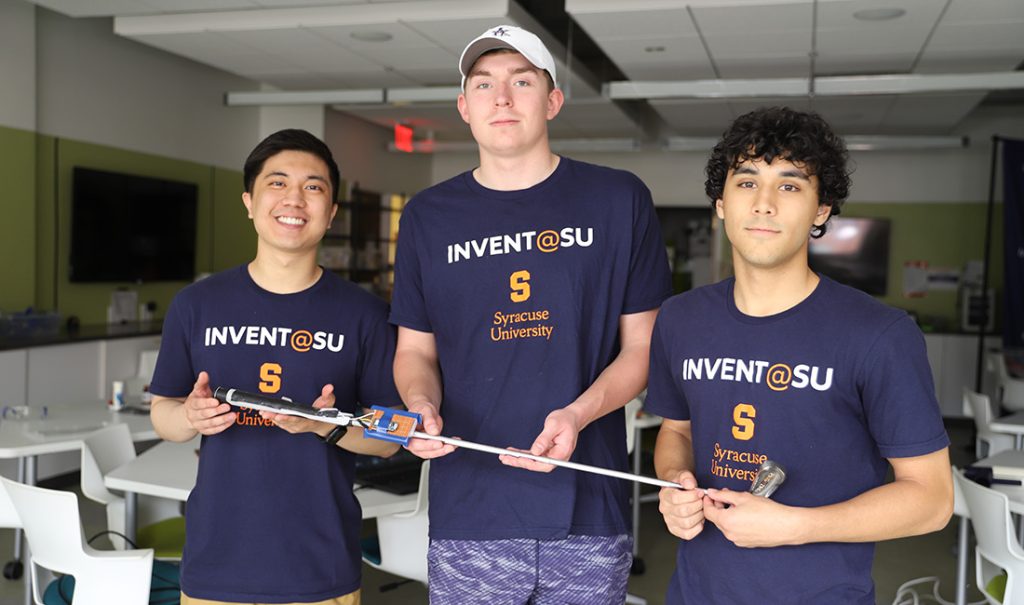
Replace

Team members: Maya Alva ’28 (aerospace engineering), Jonah Blanchard ’26 (aerospace engineering), Nana Okrah ’27 (electrical engineering), and Austin Salmonds ’27 (biomedical engineering)  

replACE is a mechanical, pedal-operated golf tee system that lets players load balls without bending, ideal for older or less mobile golfers. 
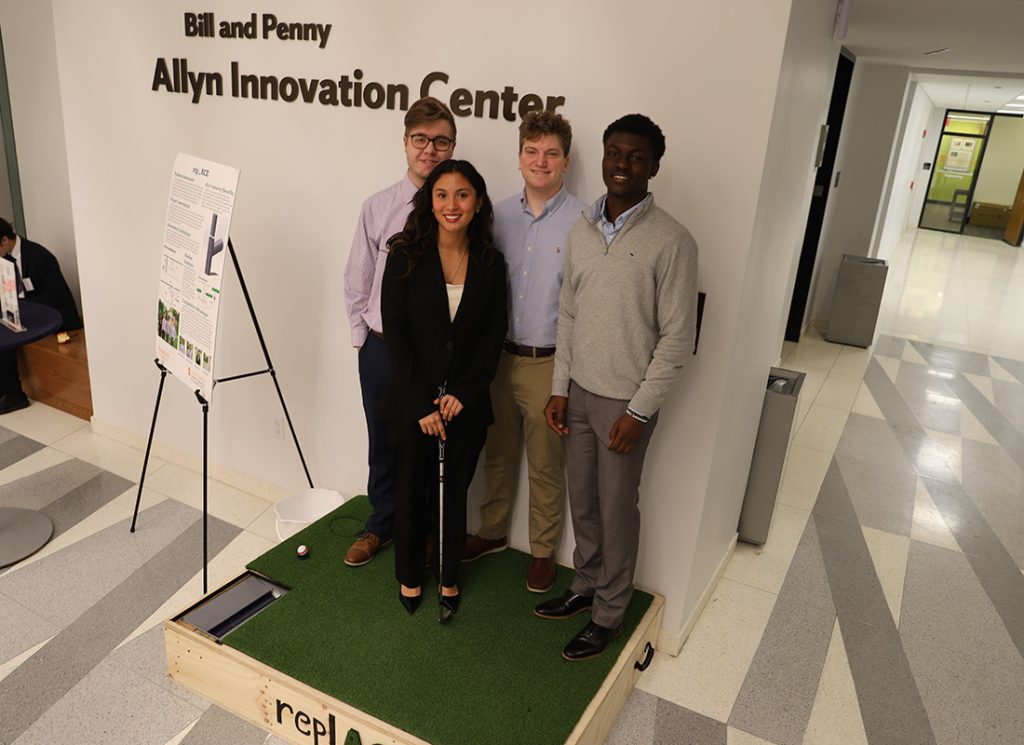
Third Eye:

Team members: Alexander Delgado ’27 (computer engineering), Angelo Fernandez ’27 (computer engineering), and Stanley Gao ’27 (computer engineering)

Third Eye is a clip-on wearable that detects people approaching from behind and sends directional audio alerts, enhancing safety and awareness for commuters and the hearing impaired.
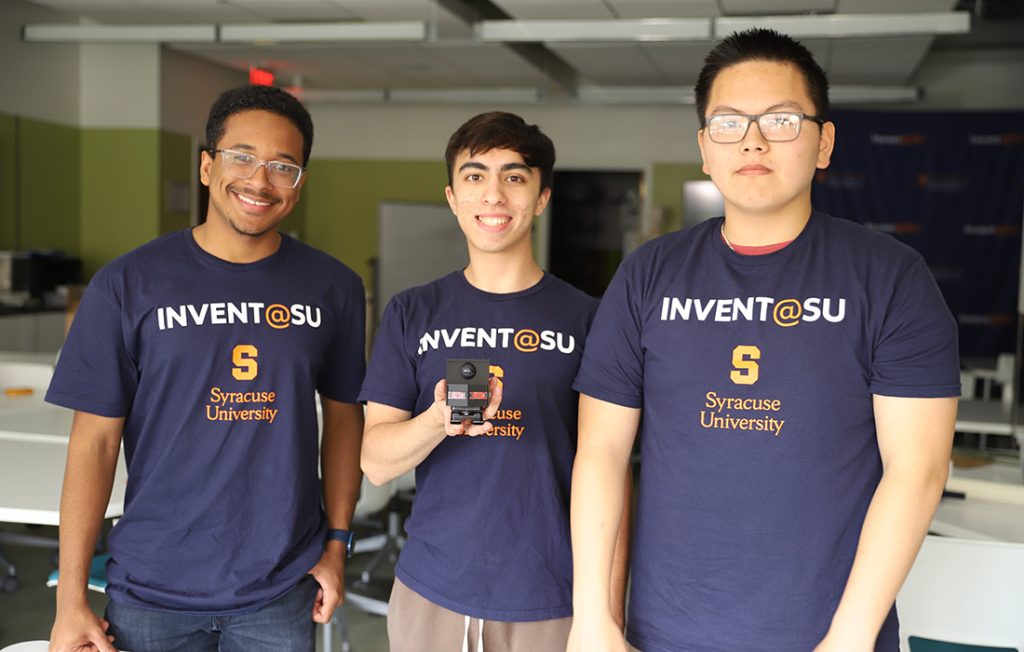
AdapTurf:

Team members: Felipe Zuluaga ’27 (aerospace engineering), Juan Jose Quintero ’26 (aerospace engineering), Cameron Mensah ’28 (computer science), and Alsime Gaye (undecided) 

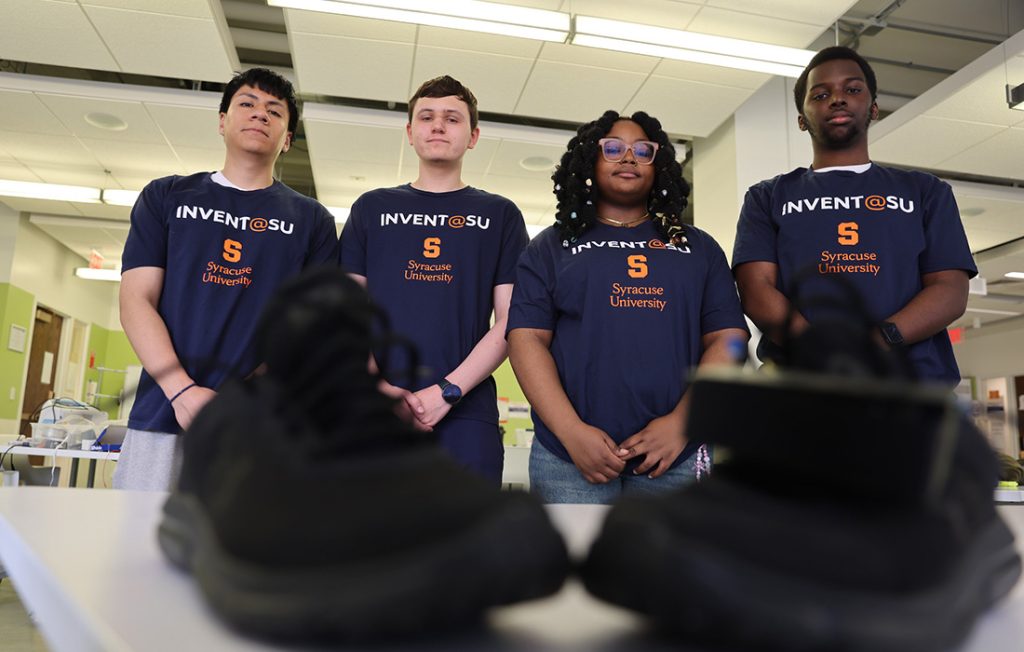
AdapTurf is an outsole system that lets athletes safely switch footwear for different sports and turfs using a secure dual locking and screw-in design.

Invent@SU was made possible by program sponsors Michael Lazar and Kim and Michael Venutolo ’77, partner sponsor the Lyons Family Foundation, and prize sponsors Rajive Dhar ‘G90 and Anita Choudry. A special thank you to Bill and Penny Allyn for sponsoring multiple years since 2017.

“Invent@SU pushes students to apply the full rigor of their engineering education—mechanics, electronics, and design—to create real-world solutions under tight deadlines. It’s an intense, hands-on extension of the classroom that challenges and transforms them,” says Kenneth and Mary Ann Shaw Professor of Practice in Entrepreneurial Leadership and Invent@SU Director Alexander Deyhim.
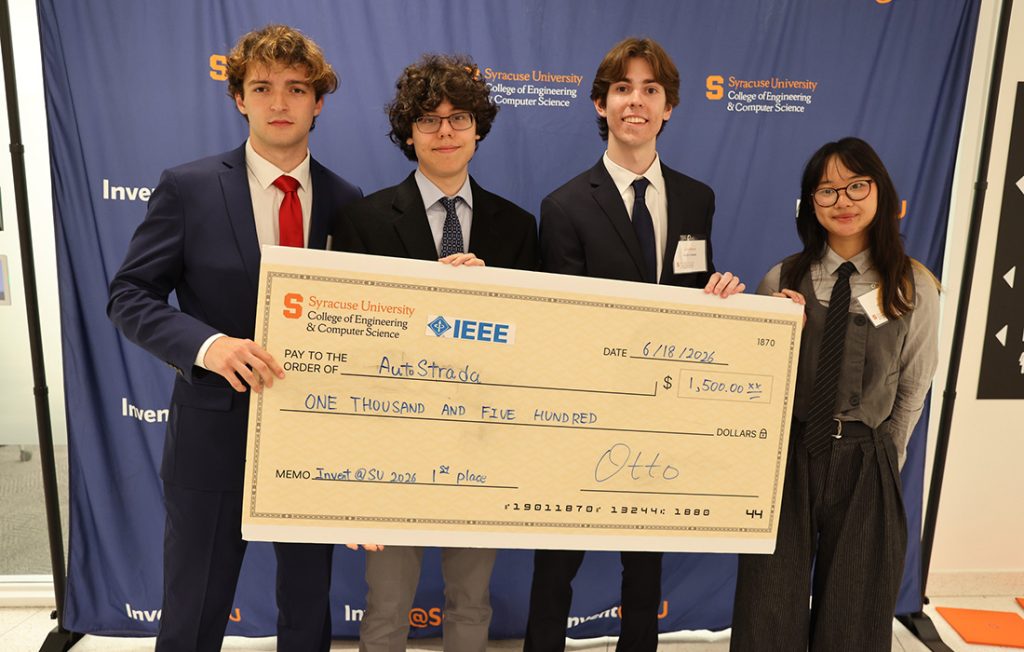
Invent@SU Students Turn Bold Ideas Into Real Solutions in Six-Week Sprint

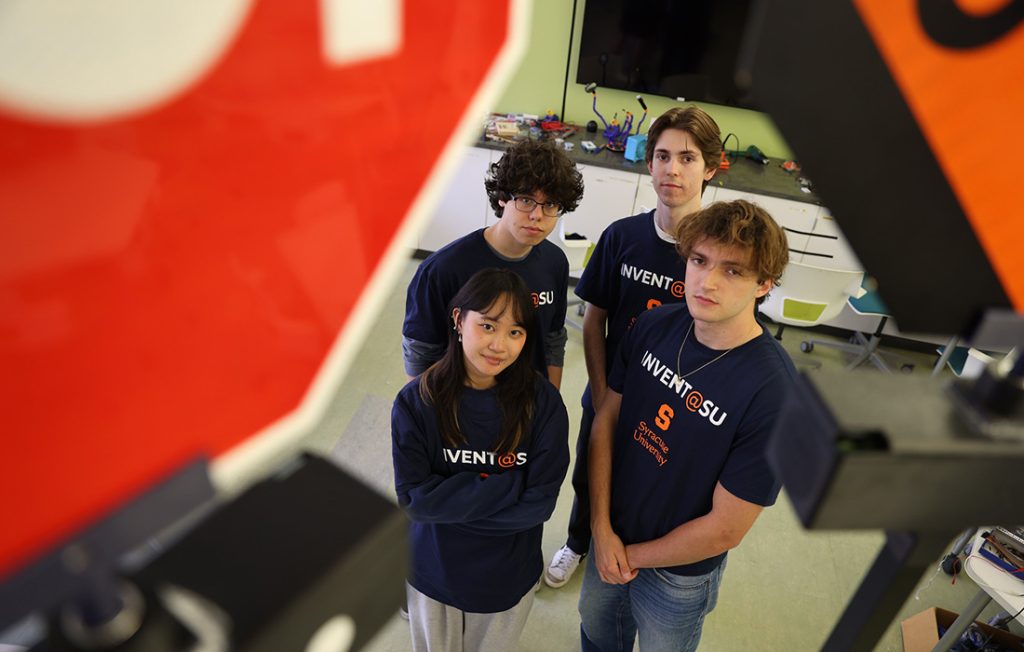
An autonomous traffic control system designed for one-lane construction zones claimed first place at the 2026 Invent@SU final judging, capping a six-week sprint in which eight student teams raced to turn raw ideas into working prototypes.

The winning invention, AutoStrada, earned top honors from competition judges. PawseMat, a smart pet wellness system designed to reduce separation anxiety by rewarding calm behavior, took second place. Tagalong, a wearable bracelet system aimed at improving student safety during field trips and group outings, earned third.


AutoStrada

Every year, thousands of construction zones rely on human flaggers to manage the stop-and-go rhythm of single-lane traffic — a job that is both tedious and dangerous. AutoStrada sets out to change that. The system uses autonomous controls to regulate vehicle movement through active construction corridors, removing the need for a stationary worker standing in the path of oncoming traffic.

For the students behind it, the project was as much about personal discovery as engineering innovation.

“I wouldn’t have had this opportunity anywhere else,” said Josh Malvino ’28, a computer engineering student. “It is uniquely Syracuse.”

Mechanical engineering student Jack Barna ’27 credited the program’s open-ended structure with unlocking the team’s productivity. “The freedom to test and develop a prototype was invaluable,” he said. “It let us build a working product in a remarkably short time.”

Electrical engineering student Heidi Ly ’28 said the experience deepened her sense of purpose. “It’s very rewarding — it validates why I love engineering. It’s hands-on, in a great learning environment.”

Computer science student Bleron Balidemaj ’27 pointed to faculty mentorship as a turning point. “The guidance and feedback from the faculty was incredibly helpful,” he said. “It gave us a clear path forward.”

PawseMat

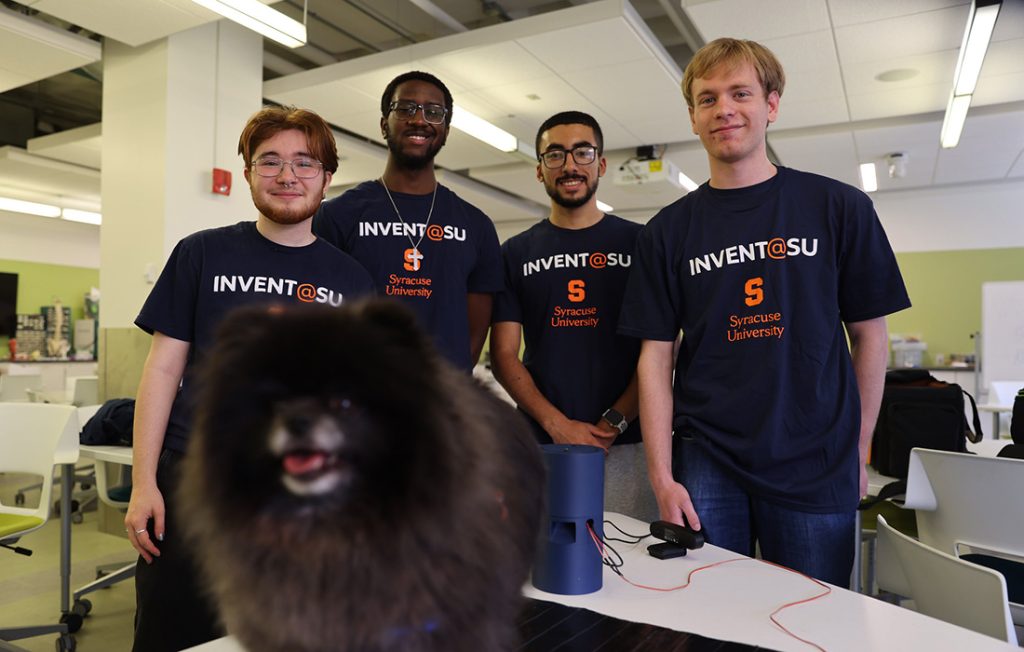
Millions of pets experience distress when left alone — but PawseMat aims to change that dynamic one calm moment at a time. The sensor-equipped mat monitors a pet’s behavior and delivers positive reinforcement when the animal remains settled, turning good behavior into a habit.

For the team behind it, the project was a bridge between classroom theory and entrepreneurial ambition.

“In this program I could apply the engineering concepts I’ve been learning — and now I can see how it could help me start my own company,” said electrical engineering student Ahmad Alawaad ’28.

Biomedical engineering student Leonardo Diehl ’28 highlighted the hands-on dimension as the program’s defining strength. “The testing and hands-on experience is really valuable,” he said.

Mechanical engineering student Aaron BenDaniel ’29 agreed. “This is real, practical experience — and that’s so important.”

For computer engineering student Brandon Isabell ’28, collaborating across disciplines fundamentally changed the way he thinks. “Working with people from different fields completely revamps your problem-solving process,” he said. “The way I approach challenges will never be quite the same.”

Tagalong

Field trips are some of the most memorable moments in a student’s education — and some of the most logistically stressful for the adults responsible for keeping everyone together.

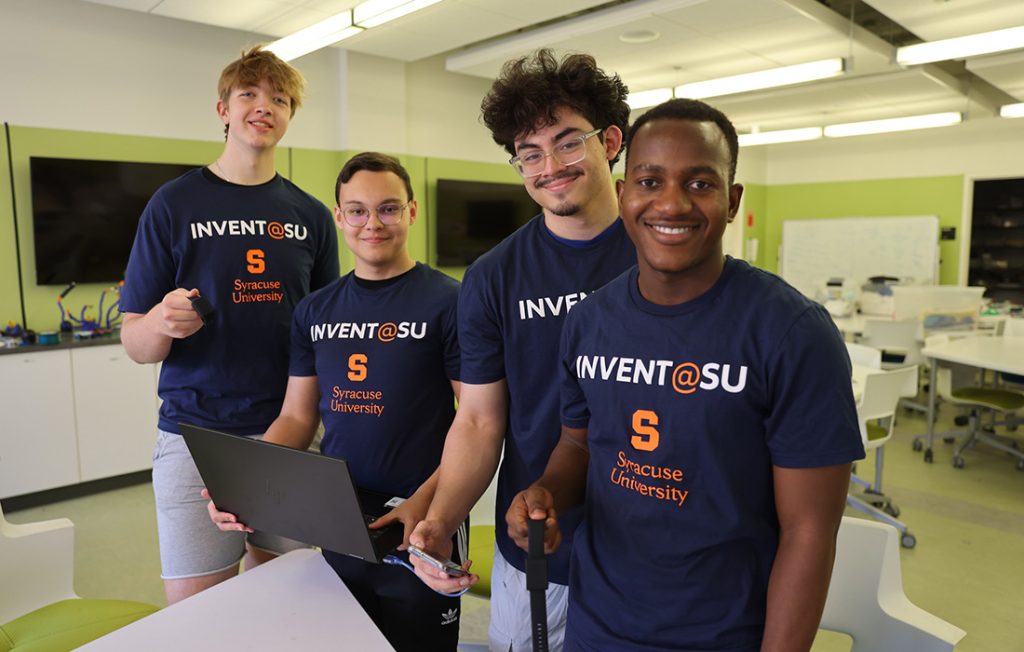
Tagalong addresses that tension with a networked wearable bracelet that gives chaperones and educators real-time location awareness, helping ensure no student slips away unnoticed.

Chemical engineering student Joseangel Montoya-Contreras ’28 said Invent@SU created rare space for genuine experimentation. “It gives you the freedom to explore your ideas,” he said. “You can actually experiment, not just theorize.”

Mechanical engineering student Humphrey Chinondo ’28 said the team has no intention of stopping here. “We plan to move forward,” he said. “Every great idea came from somewhere small.”

Computer science student Jhon Kiselev ’29 said the team’s interdisciplinary composition was essential to everything they achieved. “By combining our skills, we could accomplish so much more than any of us could have done individually.”

All eight teams received positive feedback from the judges and several plan to continue development of their inventions while working with the Couri Business hatchery, the Blackstone Lauchpad and the Innovation Law Center.

MoniDoor is a renter-friendly smart monitoring system that lets users check their door and lock status from their phone. Designed for apartments and dorms, it installs without modifying existing locks, providing added security and peace of mind.

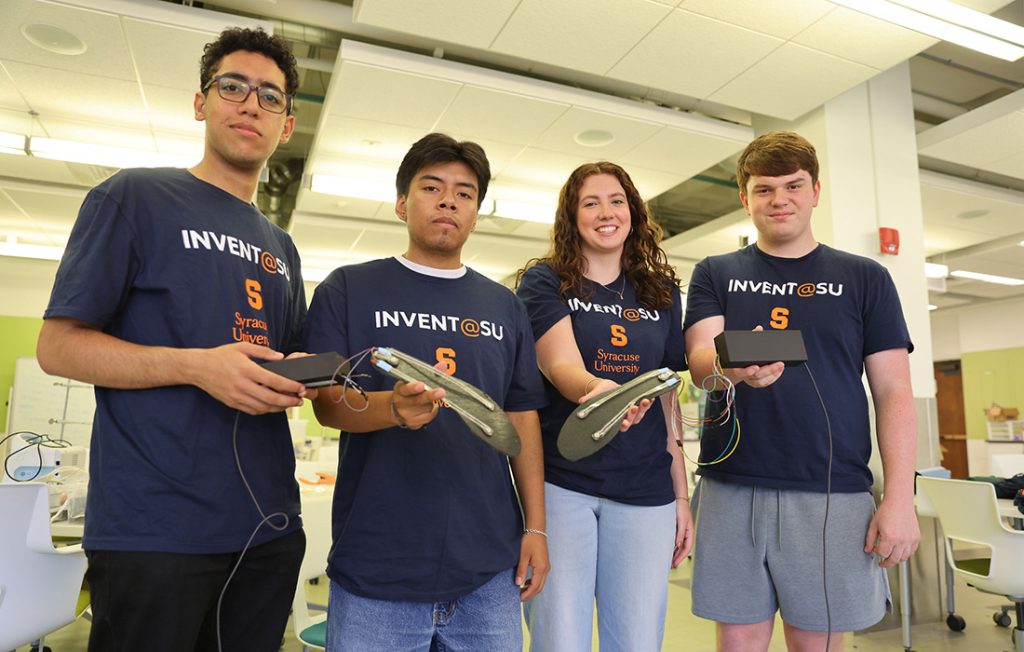
LinkSole is a smart orthopedic insole for people with flat feet that combines arch support with real-time haptic feedback. It helps users improve foot alignment, reduce discomfort, and develop healthier walking habits.

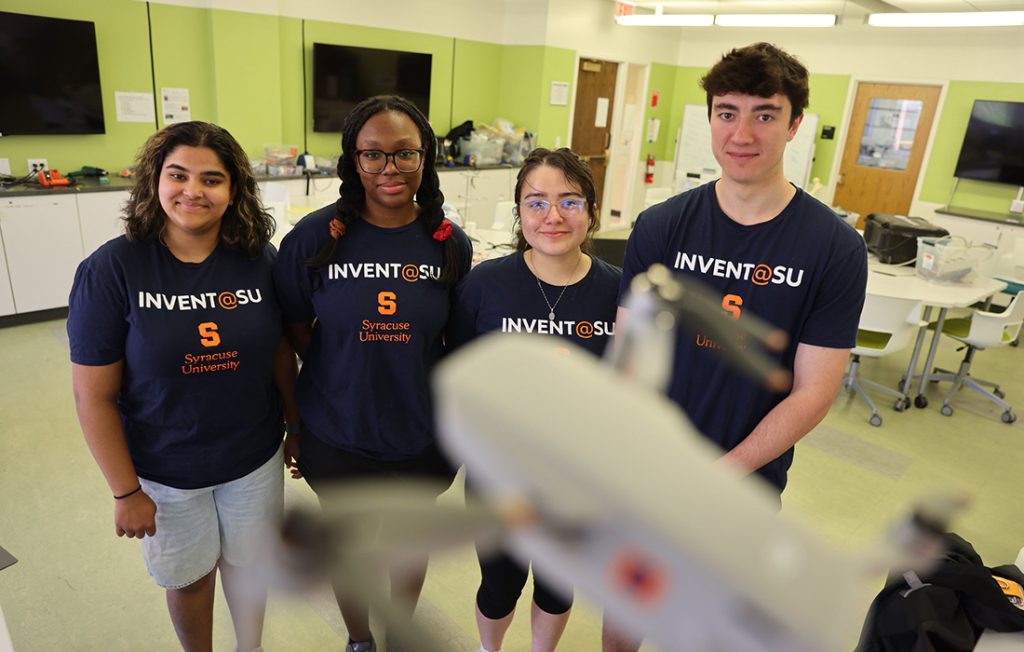
Sweep is an AI-powered litter detection system that uses drones, computer vision, and GPS mapping to identify litter hotspots. It helps organizations target cleanup efforts more efficiently and effectively.

ACL MAXX is a smart insole system that helps athletes recovering from ACL injuries monitor force symmetry between legs. It provides real-time feedback and tracks rehabilitation progress through a mobile app.

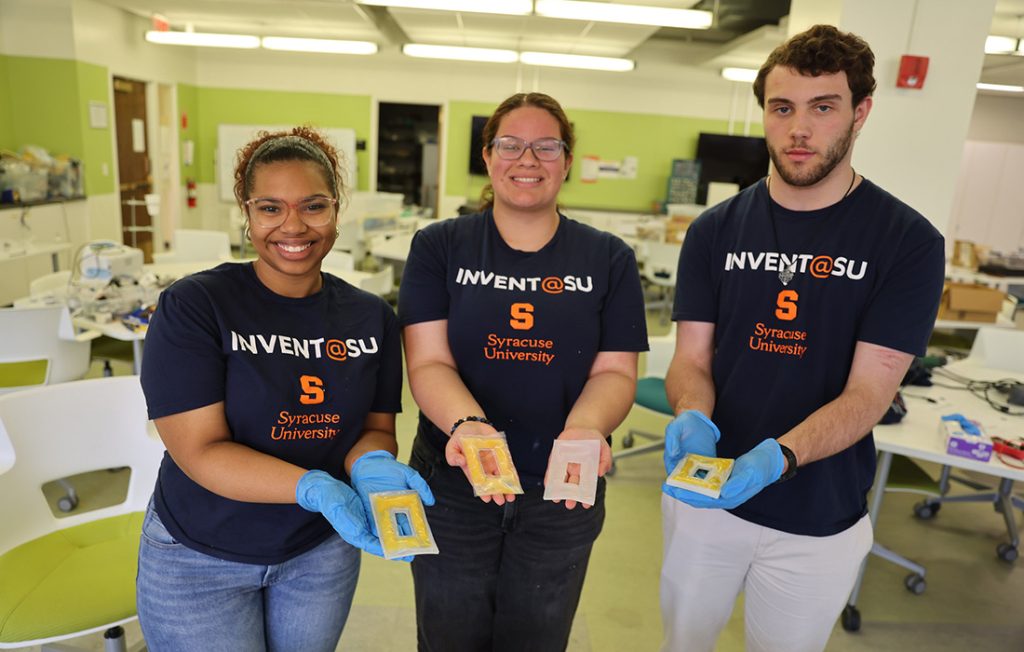
VeinWarm is a medical warming device that improves vein visibility before blood draws and IV placements. Its hands-free heating patch helps reduce needle insertion attempts, improving patient comfort and clinical efficiency.

Invent@SU is made possible through the generosity of alumni and industry sponsors, including Michael Lazar, the Lyons Family Foundation, Mike and Kim Venutolo, and Rajive Dhar and Anita Chowdhry. IEEE Entrepreneurship sponsored the prizes for the 2026 competition. Bill and Penny Allyn have supported the program across multiple years since its founding in 2017.

IEEE Entrepreneurship Partners with Syracuse University to Support Invent@SU 

IEEE Entrepreneurship, a global program portfolio within IEEE (Institute of Electrical and Electronics Engineers) that supports technology entrepreneurs, will serve as a sponsor of the 2026 Invent@SU innovation program.

Invent@SU is a hands-on, experiential program that helps undergraduate students develop into inventors and entrepreneurs. Over six weeks, students design, prototype and pitch original devices while learning about product development, innovation and intellectual property. Participants work in interdisciplinary teams to conceive new inventions, build functional prototypes, and refine both their ideas and their pitches through weekly feedback from guest evaluators.  

“Partnering with IEEE Entrepreneurship is incredibly exciting for our students and our program,” said Professor Alexander Deyhim, Director of Invent@SU and Kenneth and Mary Ann Shaw Professor of Practice in Mechanical and Aerospace Engineering at Syracuse University. “IEEE is the world’s largest technical professional organization, and this collaboration connects our students to a global innovation and entrepreneurship community.”

As part of the partnership, representatives from IEEE Entrepreneurship will participate as guest evaluators during the program, contribute to the judging panel for the final presentations and provide support for a student recognition award(s), which will be given to a participant who exemplifies an entrepreneurial mindset, demonstrates exceptional promise as an innovator, and shows a clear commitment to developing solutions that address real‑world challenges. In addition, IEEE Entrepreneurship will offer support for two Invent@SU students to attend Web Summit Lisbon, one of the world’s leading technology and startup conferences, to broaden their exposure to global perspectives in entrepreneurship. 

“IEEE Entrepreneurship is committed to supporting the next generation of technology entrepreneurs. Invent@SU provides an environment where students can explore ideas, build skills, and gain confidence as emerging innovators, and we are proud to contribute to that learning experience,” said Mohamed El Dallal, 2026 Chair of IEEE Entrepreneurship.

The 2026 Invent@SU program will run from May 11 through June 18, culminating in a final showcase where student teams present their inventions to a panel of judges, industry leaders and Syracuse University leadership.

Interdisciplinary Engineering Teams Design, Prototype and Pitch Original Devices at Invent@SU 2024

Eight teams of engineering students presented designs for original devices to industry experts and investors. These students were part of Invent@SU, a six-week summer program where students design, prototype, and pitch to judges.

On June 20th, the teams gave their final pitch presentations to a panel of 14 expert judges. The room was filled with guests, including Dean Cole Smith, Syracuse University Life Trustee Bill Allyn and program supporter Mike Lazar. The event kicked off with poster presentations that gave the student teams the opportunity to showcase their inventions and answer questions from the judges.

This year’s competitors were:

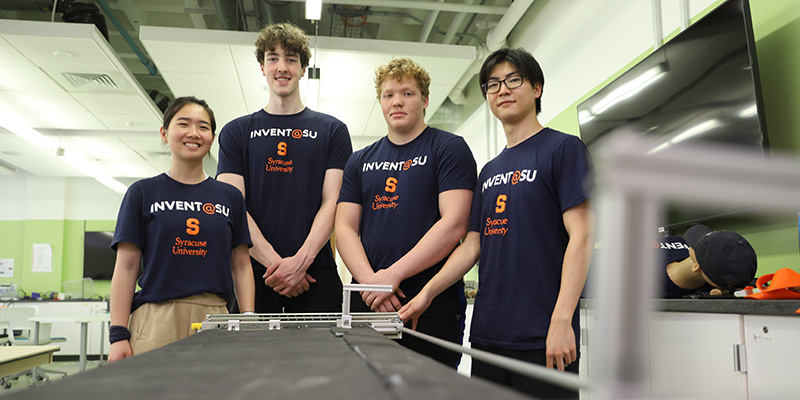
Team TreadBed students Sandy Lin, Ian Roche, Colin Wanderman and Jason Bae

TreadBed: Jason Bae ’25 (biomedical engineering), Sandy Lin ’25 (computer science), Ian Roche ’25 (mechanical engineering), Colin Wanderman ’27 (mechanical engineering)

A patient transfer device that reduces the amount of lifting required for caregivers when moving a patient between a stretcher and a hospital bed. 

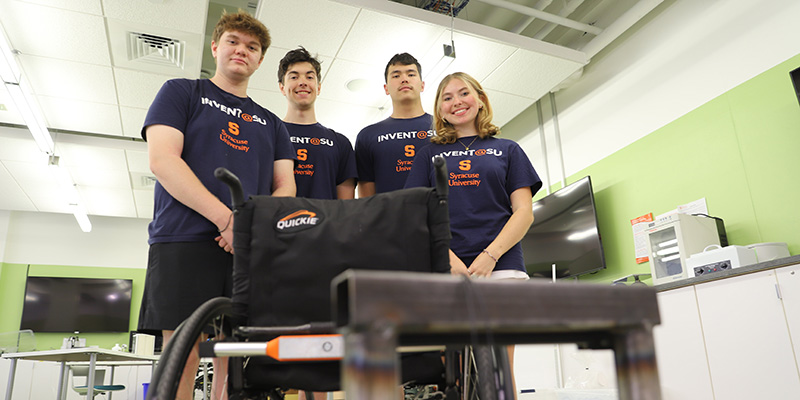
Team MagniClaw students Carter Thompson, Davis Hood, Matthew Pinto and Jennifer Mason

MagniClaw: (Tied for Second Place) Davis Hood ’26 (electrical engineering), Jennifer Mason ’26 (mechanical engineering), Matthew Pinto ’27 (biomedical engineering), Carter Thompson ’26 (aerospace engineering)

A device that securely locks wheelchairs in place for moving vehicles.

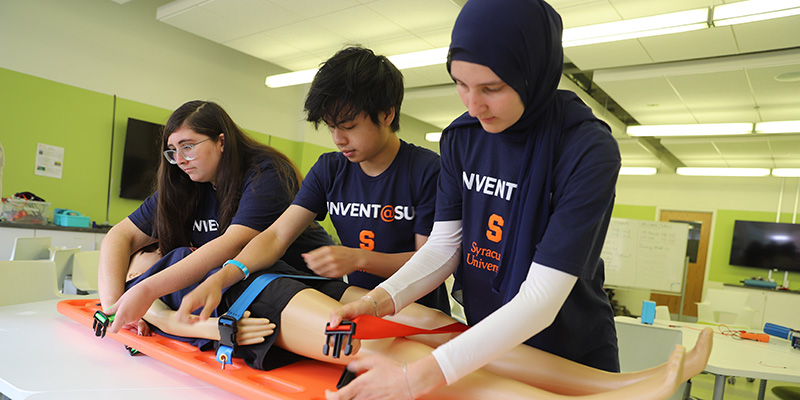
Team SwiftStraps students Jessica Moreno, Patrick Phanichyakarn and Amira Salihovic

Swift Straps: (Tied for Second Place) Jessica Moreno ’26 (aerospace engineering), Patrick Phanichyakarn ’26 (mechanical engineering), Amira Salihovic ’25 (biomedical engineering)

Retractable, color-coded restraint straps that make transferring or transporting EMT patients more efficient.

Team R!G students Jair Espinoza, Robert Adinolfi, Brayden Phillips and Ava Lubkemann

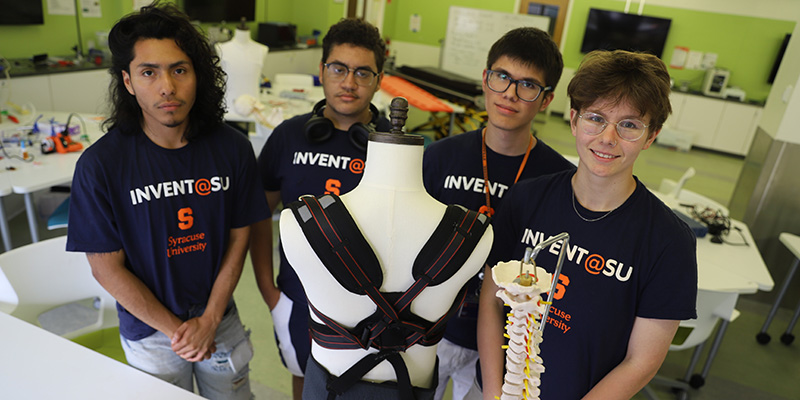
R!G: (Third Place) Robert Adinolfi ’28 (mechanical engineering), Brayden Phillips ’27 (chemical engineering), Jair Espinoza ’25 (computer science), Ava Lubkemann ’27 (environmental engineering)

A lightweight, breathable suit that helps correct posture and provides lumbar support.

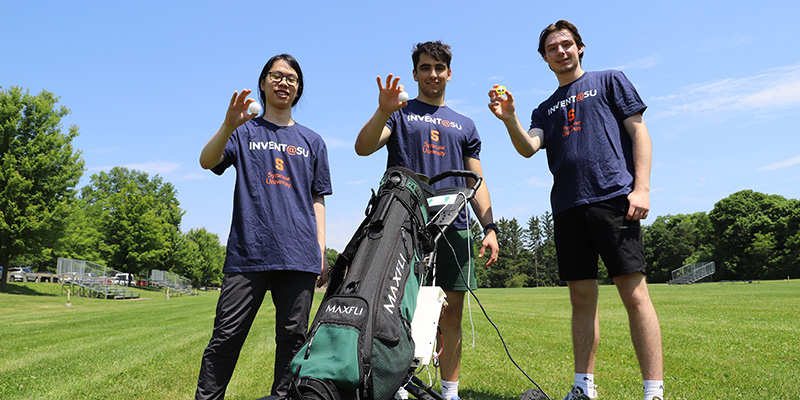
Team Caddytrack students Tom Xiao, Giancarlo d'Amore and Daniel Stitch

CaddyTrack: Giancarlo d’Amore ’26 (mechanical engineering), Daniel Stitch ’26 (mechanical engineering), Tom Xiao ’28 (mechanical engineering)

A golf cart that can track your ball and autonomously drive to the ball’s location.

Team Phloat students Nathan Brekke, Joshua Varkey, Malak Aljerari and Elijah Alexander

Phloat: (First Place) Elijah Alexander ’27 (civil engineering), Malak Aljerari ’27 (biomedical engineering), Nathan Brekke ’26 (computer science), Joshua Varkey ’26 (aerospace engineering)

A phone case that has a compact, deployable flotation feature that activates if the phone falls into deep water.

Team GymIn students Jack Friedman, Antonio Goncalves, Alexander Hamza and Armani Isonguyo

GymIn: Jack Friedman ’27 (chemical engineering), Antonio Goncalves ’27 (computer science), Alexander Hamza ’26 (biomedical engineering), Armani Isonguyo ’25 (computer engineering)

A service that allows gyms to gather data on usage of their equipment.

Team KARE9 students Richard Nguyen, Juliana Sepulveda, Malika Saidhedkar and Uchechukwuka Obiofuma

Kare9: Richard Nguyen ’27 (mechanical engineering), Uchechukwuka Obiofuma ’25 (computer engineering), Mallika Saikhedkar ’26 (computer science), Juliana Sepulveda ’25 (biomedical engineering)

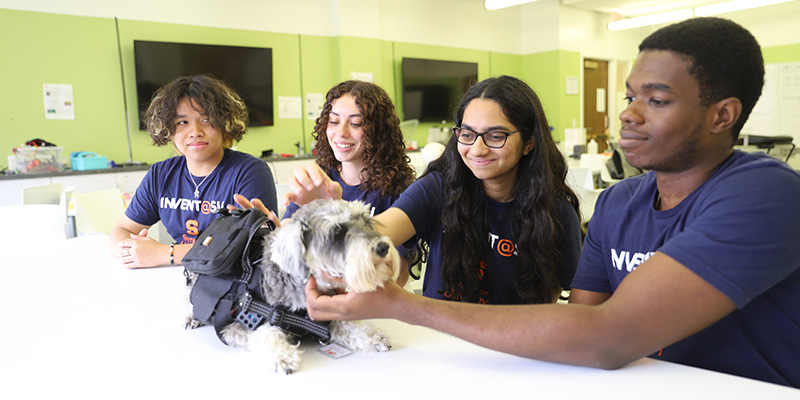
An all-inclusive solution for monitoring your dog’s health and ensuring their safety through a health harness. 

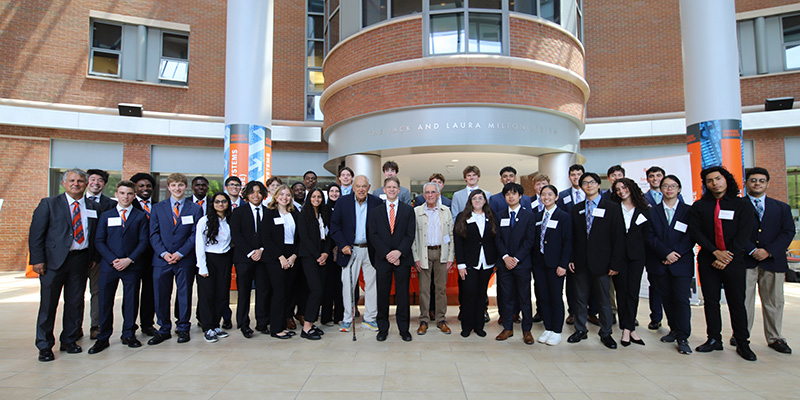
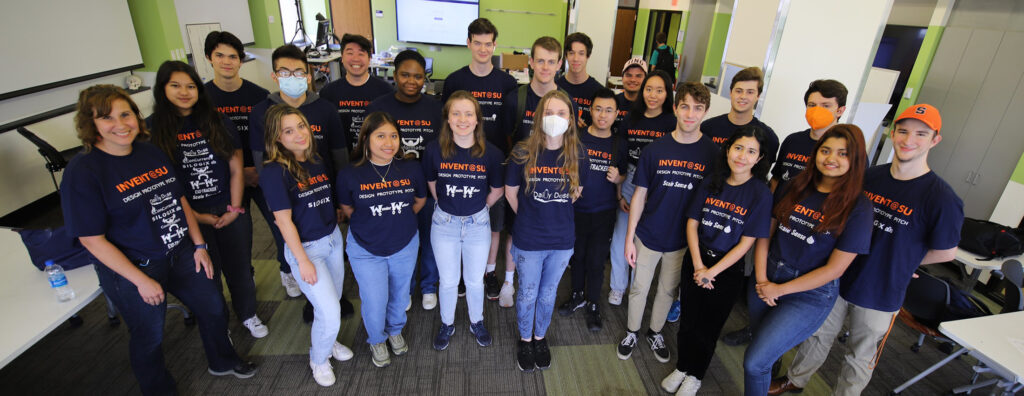
The students, faculty and supporters of Invent@SU 2024

Invent@SU is made possible by program sponsor Michael Lazar, partner sponsor the Lyons Family Foundation, and team sponsor Ralph Folz. A special thank you to Bill and Penny Allyn for sponsoring multiple years since 2017.

“Students learn about design, ideation and intellectual property, then conceive an original invention, prototype the invention and refine it in response to weekly feedback from diverse audiences of guest evaluators. In addition, students learn key business, entrepreneurship and professional skills, such as: communication, creating a “pitch,” financing a start-up, sustainable design, accounting, marketing, pricing, leadership and teamwork,” said Professor Alex Deyhim. “All 8 teams did an amazing job and walked away with invaluable lessons learned and friendships that will last a lifetime.”

Interdisciplinary team of Engineering and Computer Science Students Wins 2022 Invent@SU Competition

When searching a burning building for people who may be trapped inside, smoke and debris can cause firefighters to work in zero visibility conditions. They are attached to ropes but it is easy for them to become disoriented. This makes it difficult to navigate their way back to safety.

Environmental engineering student Oliver Raycroft ’25 heard about the problem from a firefighter during his first year at the College of Engineering and Computer Science and started thinking about ideas.

“I thought the problem was interesting and there was a clear need,” said Raycroft. “I wanted to help and find a solution.”

At the beginning of the six week Invent@SU program, Raycroft presented the problem to his teammates biomedical engineering student Alejandra Lopez ’22 and computer science student Adya Parida ’25. Both were interested in seeing if they could use their science and engineering skills to design a practical solution that would help firefighters orient themselves during rescue operations.

“If we could solve this problem, we could save the lives of firefighters and billions in damages,” said Parida.

During Invent@SU, student teams design, prototype and pitch new inventions with help from engineering and communications faculty. Each student receives a $2200 stipend and teams have a $1000 budget for prototyping materials. Teams spend six weeks developing their ideas during summer session one and each week a panel of Syracuse University alumni and friends evaluate the progress of their five-minute pitches.

“It was a combination of experimentation and feedback. This program taught me skills I can apply anywhere,” said Parida.

“I got better and better at presenting and communicating what we were working on,” said Lopez.

Raycroft, Lopez and Parida developed an initial prototype that would attach to rescue ropes and indicate directionality to firefighters who were working in zero-visibility. As they considered adjustments and materials for their next version, the team brought the initial prototype to the Oswego Fire Department to get their feedback and input.

“The fact firefighters liked it so much made it worth it,” said Parida.

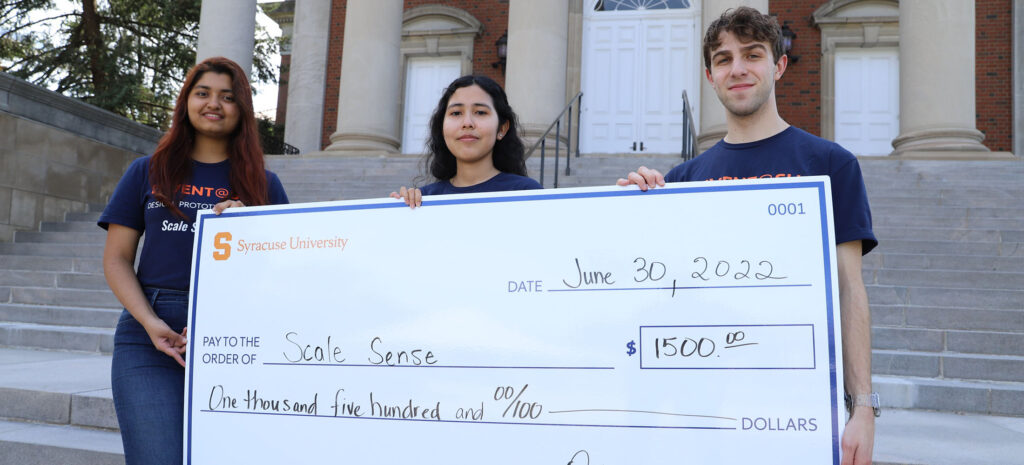
On the final Thursday of the program, all seven teams in Invent@SU pitched their inventions to a panel of alumni judges. Raycroft, Lopez and Parida’s team named “Scale Sense” took first place and a $1500 prize.

Second place went to team “Wonder Walker” who designed a mobility assistance device for children with special needs.

Third place went to team “Silogix” – who designed a device to provide farmers with a way to prevent dangerous grain blockages in silos.

“It was a ride, it was fun, challenging and rewarding,” said Parida.

Several Invent@SU teams plan to work with the Blackstone Launchpad in Bird Library to explore business plans and patents.

Invent@SU was made possible by program sponsors Syracuse University Trustee Bill Allyn G’59 and Janet “Penny” Jones Allyn ’60 and Michael Lazar G’65. The 2022 team sponsors were Matthew Lyons ’86, Haden Land G’91 and Cathy Jo Land and Ralph Folz ’90. For more information on the program, visit invent.syr.edu.

Biomedical and Chemical Engineering Spotlight: Bianca Andrada ’22

Bianca Andrada is the 2022 Recipient of the Bioengineering Founders Award.

Hometown:

New York City

BMCE/ECS/other activities you have been involved with:

  • Dr. Pranav Soman Research Lab
  • President of Engineering World Health
  • President of Kappa Phi Lambda Sorority, Inc.
  • 3+ Resident Advisor for Engineering and Computer Science Living Learning Community
  • Honorable Mention Recipient for Invent@SU
  • TA for Invent@SU Summer 2022
  • Engineering Excelerators
  • Tau Beta Pi – The Engineering Honor Society
  • Mentor Biomedical Engineering Society
  • Food Recovery Network
  • Guest Services – Barnes Center at the Arch Recreation

Favorite thing about BMCE:

My favorite thing about BMCE are the faculty and staff. They have all been supportive of my interests, passions, and they ensured that my studies revolve around them. For instance, I expressed my curiosity in CAD Design to Dr. Yung. He was able to connect me with the Industrial and Interaction Design School so I can bridge together my interest in design and engineering.

Favorite thing about Syracuse University:

On the engineering side, I had the opportunity to be a part of a multitude of projects that provided opportunities to prove to individuals my depth, understanding, and skillset in biomedical engineering. On the social side, I love going to the Basketball Games with my friends. 

Plan after graduation:

After graduation, I will be obtaining a Master of Science in Robotics and Autonomous System at Boston University. My focus will be in medical and soft robotics.