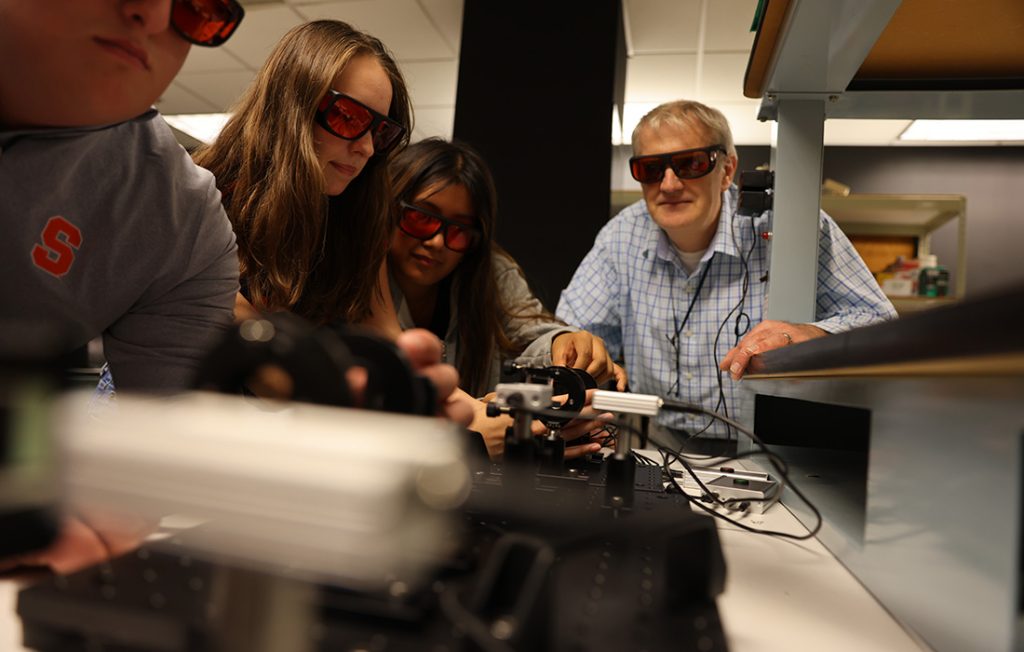
Students and faculty from the College of Engineering and Computer Science attended the 2025 National Advanced Technological Education (ATE) Principal Investigators’ Conference in Washington, D.C.
electrical engineering
Electrical Engineering and Computer Science Professor Moamer Hasanovic Receives NSF Award for Quantum and Semiconductor Workforce Development
Moamer Hasanovic, Assistant Teaching Professor in the Department of Electrical Engineering and Computer Science, has received a National Science Foundation (NSF) Experiential Learning for Emerging and Novel Technologies (ExLENT) award for quantum and semiconductor upskilling. Hasanovic will develop an educational program to give adult learners hands-on preparation for semiconductor, optics, and quantum technology careers.
NSF’s ExLENT program is designed to support experiential learning opportunities in emerging technology fields. The program is especially focused on eliminating barriers to STEM education for adult learners by providing training programs that lead to new career pathways.
Professor Hasanovic’s program, Quantum and Semiconductor Upskilling for Career Change through Experiential Education Deployment in Central New York (Q-SUCCEED-CNY) will span over six semesters and offer training on specific technologies, interactive demonstrations, industry talks, and mentorship. Workshops will take place in the evenings and on weekends to accommodate working adults. Each semester-long cohort program will conclude with a five-day immersive bootcamp covering topics like clean room protocols, semiconductor processes, optical measurements, and laser applications.
“This was truly a collaborative effort, and I express my deepest gratitude to all the internal and external partners who contributed to this proposal,” says Hasanovic. “I look forward to working with them – not only on this project, but on future efforts that aim to build a stronger regional tech workforce. By connecting adult learners with emerging technologies and real industry pathways, we’re not just preparing individuals for new careers – we’re investing in the long-term economic strength and innovation potential of Central New York.”
“This award strengthens Syracuse University’s growing leadership in semiconductor and quantum education and research,” says Alex K. Jones, Klaus Schroder Endowed Professor and Chair of Electrical Engineering and Computer Science. “Alongside our increasingly recognized activities in areas such as artificial intelligence and wireless communications, Professor Hasanovic’s program further positions the University at the forefront of innovation in the nation’s most critical technologies.”
Hasanovic has extensive experience in teaching and program development for quantum-enabled technologies, as well as a long career in radio-frequency engineering and design. Q-SUCCEED-CNY builds on the success of EdQuantum, an NSF-funded curriculum Hasanovic created for photonics technicians, and other Syracuse University programs for semiconductor workforce training.
In addition to creating the EdQuantum program, Hasanovic has authored several electrical engineering textbooks and manuals. With both a PhD in Electrical Engineering and an MBA from Syracuse University, he is uniquely equipped to develop collaborations between industry and academia.
Hasanovic will lead Q-SUCCEED-CNY as Principal Investigator (PI), with support from Jones and Professor Prasanta K. Ghosh as Co-PIs. The program is an interdisciplinary effort, integrating career coaching through the College of Professional Studies, and will also leverage partnerships with Onondaga Community College, the Manufacturers Association of Central New York, Jubilee Homes, Westcott Community Center, and other regional businesses and community-based organizations.
Electrical Engineering Alumni Profile: Steve Harvey ’91
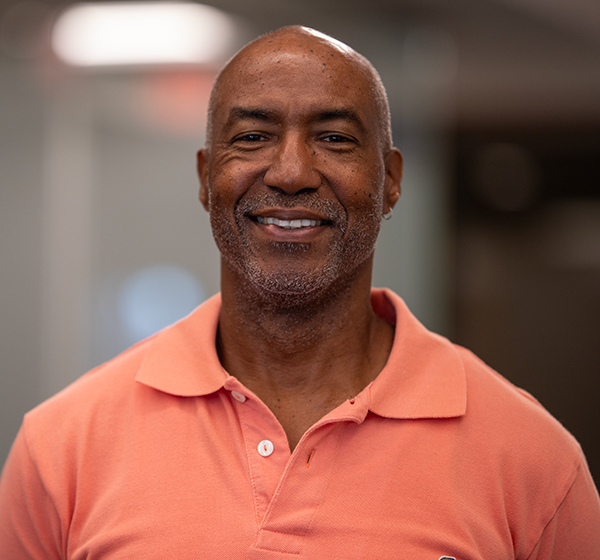
Before he even knew he wanted to be an engineer, Steve Harvey ’91 was applying his aptitude for problem-solving to figure out his own path to college. Despite solid grades and a desire to learn, Harvey’s high school guidance counselor suggested he wasn’t college material. It was a formative moment at the onset of his career journey, and it became a driving force that led him to Syracuse University as a first-generation student, where he graduated with a bachelor’s degree in electrical engineering and a minor in mathematics.
“Even as a non-traditional student, there are a lot of opportunities out there that you may not be aware of, but when you have the right connections and the right exposure, it can come to life for you,” says Harvey.
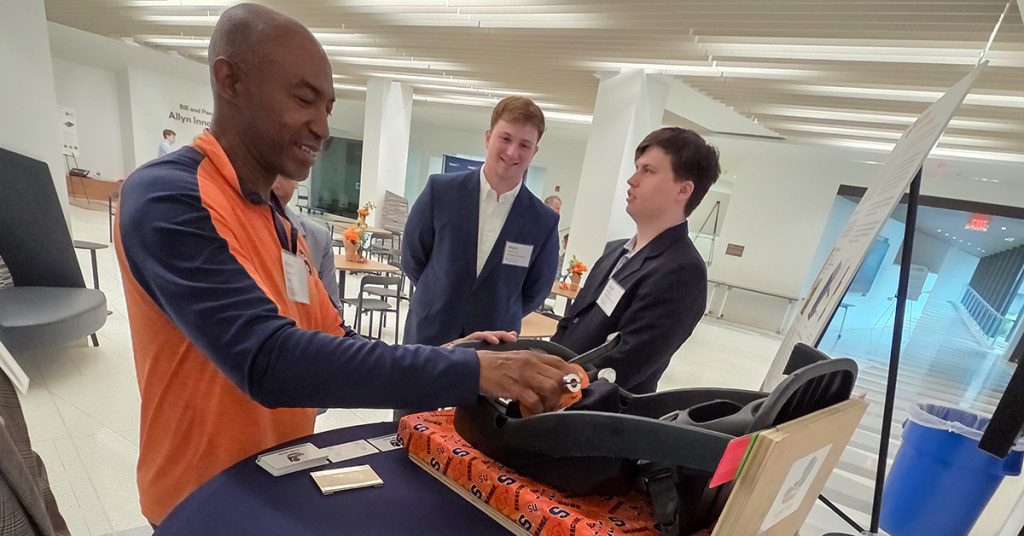
Harvey, now retired after a successful career in telecommunications, recently returned to campus, drawing on his early experiences to mentor a new generation of innovators. During the summer of 2025, Harvey participated as a judge for Invent@SU, a program that challenges students to design, prototype, and pitch an original invention in only six weeks. Harvey observed it’s a hands-on, collaborative experience that not only accelerates student development in technical areas, but also around key accessory skills like communication and presenting. Something he says could have been beneficial during his time in college.
“It would have made me a little bit more comfortable. I think every engineering student would benefit,” says Harvey. “I would love to participate again. There were some really good projects.”
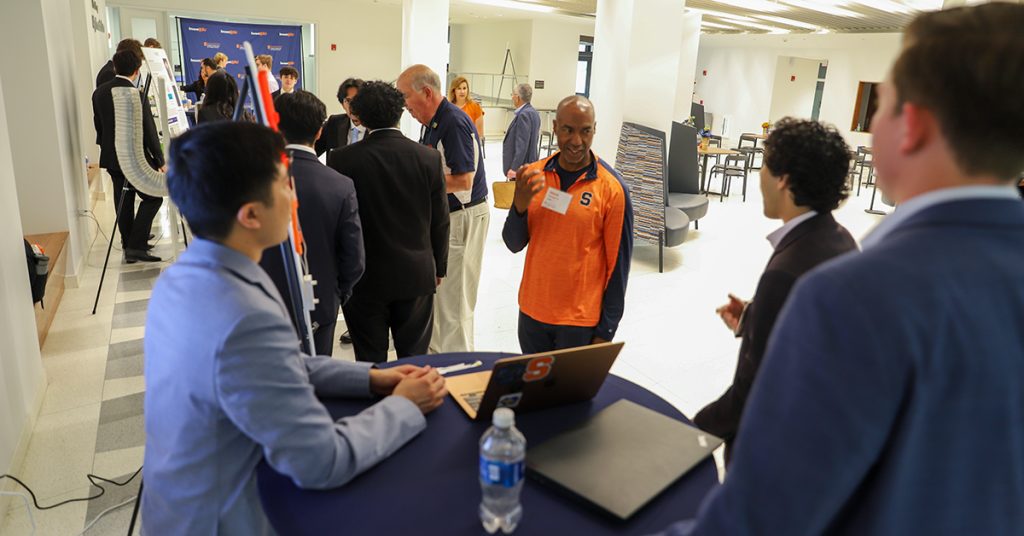
Lacking guidance and mentorship, after high school, Harvey joined the military, and he immediately received a strong evaluation for his abilities in science and math. He also developed a strong sense of discipline that would become the cornerstone of his skillset. Following nearly a decade on active duty as a radar tech, Harvey entered the reserves and obtained a job at General Electric in Syracuse, NY, as an engineering system test technician. In contrast to his experience in high school, his commanders in the military pushed him to succeed, and the experience ignited an early insight into the value of leadership and mentorship.
“It was a profound influence because now I felt like someone really cared about me, saw the potential that I had, and wanted to foster and mentor it,” says Harvey.
By chance, another member of Harvey’s unit graduated from Syracuse University and recommended he apply. The drive and discipline that brought Harvey to the University were directed toward achieving his degree while continuing to work his full-time job. His mission-based approach helped him focus on reaching his goals and managing a packed schedule, but he says it came at a cost.
“Being so driven and so focused, I didn’t build the connections I should have built,” says Harvey.
Harvey didn’t completely understand the importance of community and networking. It’s a common challenge and a significant disparity in the college experience of a first-generation student. Looking back, Harvey believes resources that aid these students in identifying blind spots and enable them to focus on academics would make a life-changing difference.
“Having that person to guide them, letting them know what the pitfalls are, and letting them know the things they really need to concentrate on, they really need someone to guide them,” says Harvey.
Harvey found mentorship as a member of NSBE (National Society of Black Engineers). Leaders for NSBE helped him make connections with recruiters that led to multiple job offers, including one he accepted from Lockheed Martin. The position pushed Harvey to expand his skills by developing his programming abilities and introducing him to coding techniques and different types of databases. Despite coming into the role without much experience in either area, Harvey’s electrical engineering background proved he could learn, innovate, and problem solve.
“Having an engineering degree, as soon as I got to Lockheed, I was given more and more opportunities because they knew I had that foundation.” says Harvey. “It built on top of what I learned at Syracuse University.”
The experience at Lockheed Martin launched Harvey into telecommunications. He transitioned to Motorola and eventually AT&T, where he rooted his career in transmitting, encrypting, and securing data. It was an exciting time because it placed Harvey at the forefront of the data revolution that led to the arrival of new technologies that are reshaping the world today. For aspiring engineers and computer scientists, Harvey emphasizes that data is just getting started.
“If I was an engineering student now, I would concentrate on all forms of data. Data is the future. Data is going to drive everything,” says Harvey. “If you can master different techniques like how it’s stored, analyzed, transmitted, and secured, that will probably be a big focus.”
First-generation students arriving at Syracuse University today find considerably more resources, but barriers remain. The College of Engineering and Computer Science is committed to providing a supportive environment where every student can thrive while receiving a world-class education that can change their life. For non-traditional students unsure of how to forge a path to higher education, Harvey says the first step is self-assurance, to believe in your ability to navigate uncertainty and to have the courage to discover and take advantage of opportunities.
“Don’t sell yourself short. Even though someone might tell you when you’re young that you’re not college material, but if you feel that you are and you want to do it, listen to what you’re saying inside.”
Electrical Engineering Student Profile: Ellie Parkes ’26
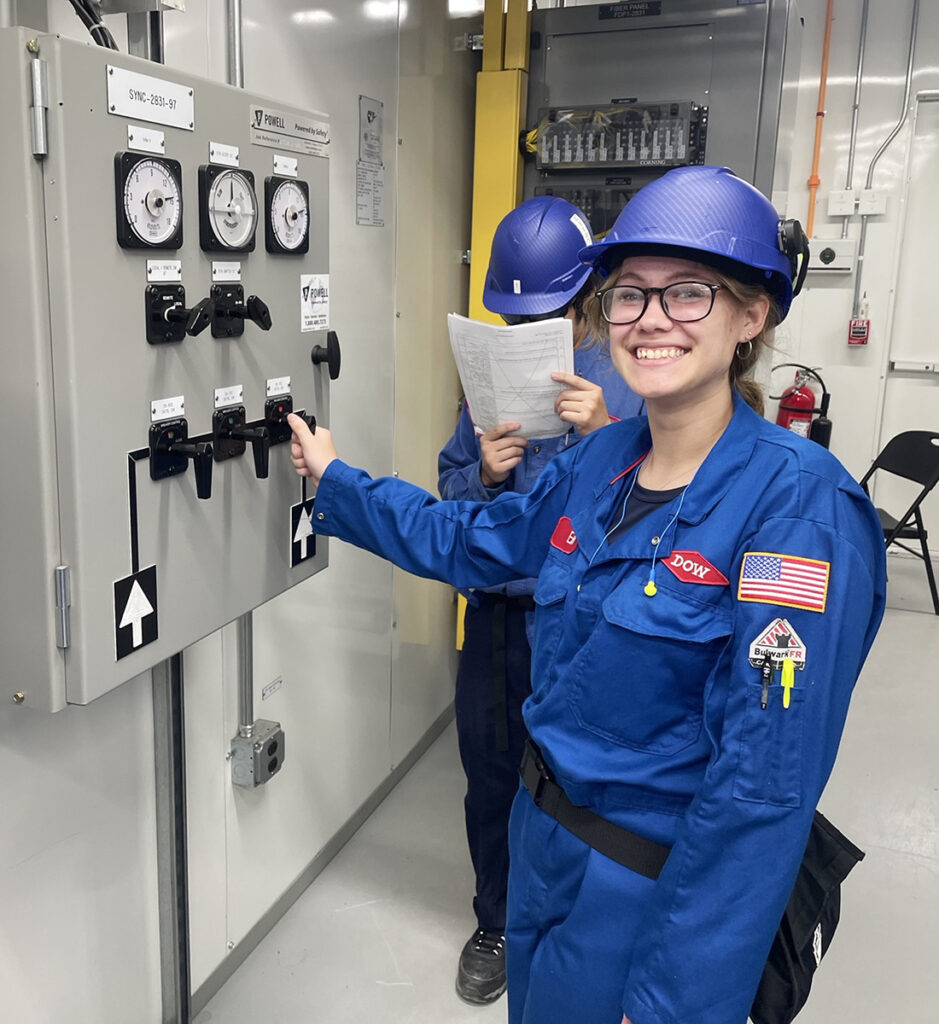
Ellie Parkes ’26 got a charge out of her internship with Dow, one of the world’s leading materials science companies. Parkes, an electrical engineering major worked on projects to improve energy production at the company’s operations plant in Baton Rouge, Louisiana. “Electrical engineering is such a broad field, and this exposure to one of the career paths I could take has really helped me understand what my future looks like,” she says.
Admittedly, Parkes wasn’t familiar with Dow when a representative contacted her through Handshake about a hiring expo for electrical engineers, but she followed up. In interviews, she fielded both situational and technical questions, and when an offer came her way, she accepted and spent 12 weeks in Louisiana.
The company’s industrial complex generates, distributes and uses its own power, and was replacing old equipment, dating back as far as the ’50s, as part of a new multimillion-dollar grid, she says. “My major projects were looking for improvement opportunities at our lower voltage levels (mostly 2400V), such as making existing electrical setups more reliable.” Parkes was also involved with work on the new transformers. “There was definitely a lot of coordination that had to take place given how many things were going on at one time,” she says.
Parkes stands in front of a transformer that was being renovated. It connects a gas turbine to a network of cables that eventually take power to the plant’s grid.
These experiences helped Parkes recognize the importance of communicating across disciplines. “Most of the people I worked with on a day-to-day basis were chemical and mechanical engineers who didn’t know much about electrical systems,” she says. “Being able to communicate high-level electrical concepts through images and metaphors has been a skill that helped me a lot through my time here.”
The most enjoyable part of the internship, Parkes says, was the variety of people she met and learned from. She forged friendships and says working with such a diverse group of people enhanced her teamwork and communication skills. Not only that, but she most likely never envisioned having a teammate who wrangled alligators on the weekends. “He offered to take my roommate and me with him when he went this summer,” she says, “but we both had to politely decline.”
Next summer, Parkes hopes to explore another electrical engineering field that interests her. “Many of the soft and technical skills I learned through working with a team will help me not only to get a job in the future,” she says, “but to also be successful in my field.”
Electrical Engineering Student Selected as an IEEE Power and Energy Society Scholarship Recipient
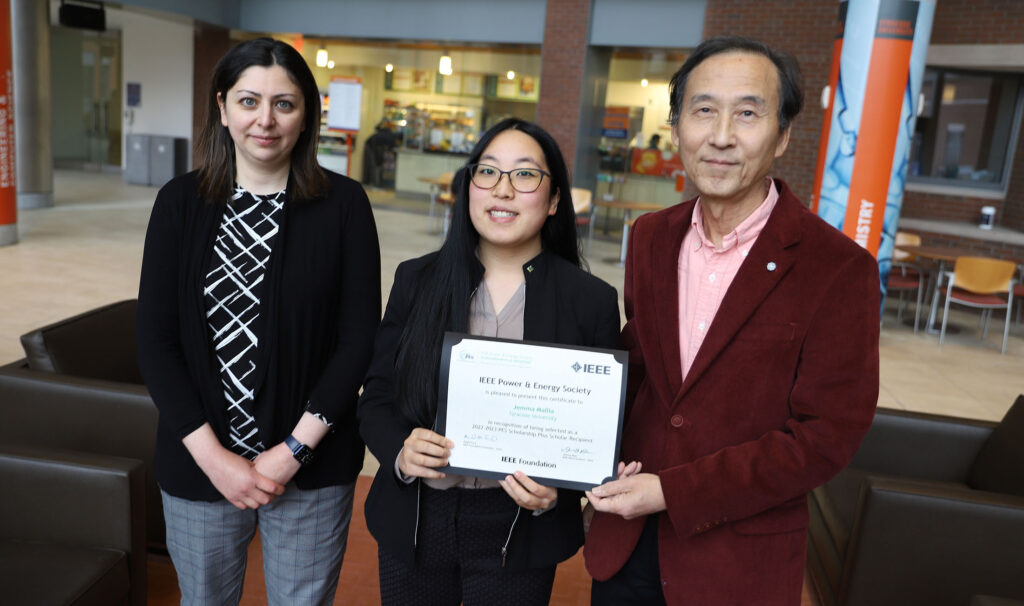
Electrical engineering student Jemma Mallia ’23 was selected as a 2022 IEEE Power and Energy Society Scholarship Plus Initiative recipient.
Mallia, vice president of the IEEE student branch, was chosen to receive the competitive scholarship by industry and academic representatives. The committee recognized Mallia for obtaining the knowledge and skills necessary to make an impact across the power and energy industry.
She was presented with the award by Electrical Engineering and Computer Science Professor Jay K. Lee, Student Activities Chair of the IEEE Syracuse Section. Mallia was recommended for the scholarship by Electrical Engineering and Computer Science Professor Sara Eftekharnejad. The research Mallia has done with Eftekharnejad’s research group was highlighted in her application.
“I am honored to be selected for this award knowing how many students are recommended for it,” said Mallia. “I’m very grateful for the support IEEE Power and Energy Society is showing for students and for supporting research related to integrating renewable energy into the power grid.”
This program includes a financial stipend along with complimentary one-year membership in IEEE and in the Power & Energy Society.
Electrical Engineering and Biomedical Engineering Alumni Profile: Grace Lanni ’88

Great ideas often disappear into a chasm that exists between inception and execution. To help bridge that gap, Grace Lanni ’88 has an innate ability to communicate with an array of stakeholders, help entrepreneurs find clarity in their ideas, and turn them into solutions that help people. Her fluency in a diverse set of subjects and ability to adapt was apparent from the start of her time as a student at Syracuse University.
Lanni entered college on a full Airforce ROTC scholarship and chose electrical engineering and biomedical engineering as part of a dual degree, along with a minor in music. Lanni found Syracuse University provided her with opportunities and resources to pursue her differing interests.
“The professors were very entrepreneurial, and I leaned into that. I was able to work with a physician at Upstate Medical Center as a lab assistant and I had other internship activities so I could apply the stuff I was learning,” said Lanni. “I also got to join the jazz band and be part of a community of musicians.”
After graduating, Lanni accepted a position where she quickly learned she was uniquely effective at communicating between two key departments.
“I would sit with the engineers in the morning and then spend the afternoon with the marketing people to explain what it was the engineers were building, and how to sell and implement the products,” said Lanni.
Lanni admits she had more fun spending time with the marketing team, and it opened her eyes to a side of business she had never experienced. This was the first of several significant shifts Lanni used to chart her career. In her next job, Lanni got a taste for selling. Then she moved to California where she took a position at a small networking hardware company and helped them grow to 35 employees within a year. The next move was to Austin, Texas and into software sales at a startup, but suddenly her momentum was stopped. After two months of being in the role, Lanni arrived at the office to find the doors chained shut. The company had gone out of business. Lanni had moved to Austin with her kids, she didn’t know many people, and did not have a job. After briefly considering retreating back to California, Lanni made some calls to colleagues and started looking for projects. Six months later she had her own company.
At the time, companies were just beginning to move servers off site to colocation centers, but the software they needed to manage the new server set up didn’t exist. Recognizing a sound opportunity, Lanni drafted a proposal and became one of only two women to score million-dollar money from a tier one venture capital firm that year. This was Lanni’s first time working with a venture group, and she says although it came with new challenges, the experience made her want to help women entrepreneurs.
“I really didn’t have any experience in the venture community. I had some support, some mentorship, but nothing like today,” said Lanni. “One of the things I love to do is support other women who want to go into the venture community and that is why. I didn’t have the support. I didn’t know what to say. I didn’t know how to manage the money. Those are skills I learned.”
Lanni broke away to work on a new startup in collaboration with Dell engineers to develop and sell an early version of the tablet PC. Lanni booked the first order, signed up the first partner and the first distributor, and after seven years she decided it was time for another move. Healthtech allowed Lanni to enjoy bioengineering and entrepreneurship, but by 2016, she went all-in on digital marketing. Lanni went to her team and asked what they thought she should focus on, and they said, “you’re a personal branding expert.” In response, Lanni launched a new business called All About That Brand to focus on helping entrepreneurs tell their stories to attract their ideal customers.
Lanni is a pioneer in the branding influencer space. All About That Brand helped bring personal brand influence into the spotlight and it took off. The platform includes an award-winning podcast, an award-winning book, and it positioned Lanni as an influencer in marketing, personal branding, and customer experience. In February of 2020, Lanni was searching for a new opportunity to innovate, and her reputation led to an invitation to appear on the cyberbullying episode of “4 Days to Save the World,” a reality show that challenges groups of entrepreneurs to develop solutions for global social problems.
The eruption of COVID-19 nearly derailed any further participation with the show because Lanni needed to focus on managing disruption facing All About That Brand. When she notified the showrunners that she wanted to step away, they countered by asking Lanni to stay on board in a new role, associate producer. It may sound like a strange role for an engineer, but both engineering and producing require a similar way of thinking.
“You have a problem in front of you almost every hour of every day. It is 24 hours of problem solving to the emergency room level,” said Lanni.
Her engineering mindset made Lanni a natural fit and within six months she became the executive producer in charge of 4 teams responsible for recruiting show-ready entrepreneurs, sponsorships, and financing to bring the show to set.
“With all my business expertise, I was able to weigh in and work directly with the studio owner and creator. It was a wonderful, wild experience for 18 months,” said Lanni. “It was like going back to college. I loved college. I learned so many new things.”
While talking with entrepreneurs around the world for the show, Lanni would often hear about the causes that mattered most to them and why. Those conversations got her thinking about how to stand out in the increasingly crowded brand space and blend her complimentary roles as a branding influencer and executive producer with her passion for helping entrepreneurs.
“When you’re talking with really smart entrepreneurs about how to save the world, it’s pretty fun. I decided I wanted to be in the conversations about cause. I wanted to help my clients identify and lean into their cause,” said Lanni.
Cause branding became Lanni’s new lane, and her latest enterprise is called Giving Out Loud. It is a media program that focuses on helping entrepreneurs select a cause that aligns with their brand and helping them demonstrate care for that cause.
“If you’re in business and you want to interact with younger generations, figure out what matters to you and talk about it,” said Lanni. “Be in that conversation because that is where things are headed.”
In the simplest terms, Lanni is an entrepreneur who wants to help other entrepreneurs at every level. Including aspiring entrepreneurs at Syracuse University.
“I am a fan of the entrepreneurship focus at Syracuse University. I love being a judge for Invent@SU and being a mentor,” said Lanni. “Have a great time and realize it is a journey. What you’re studying today is more about the people in the room than what is on the page. Really celebrate those relationships.”