Students and faculty from the College of Engineering and Computer Science brought quantum technology to life at the 2025 National Advanced Technological Education (ATE) Principal Investigators’ Conference in Washington, D.C. Hosted by the American Association of Community Colleges with support from the National Science Foundation (NSF), the event convened more than 850 grantees and partners to share their work in advancing STEM education at the technician level.
Electrical Engineering and Computer Science Professor Moamer Hasanovic and undergraduate students Thomas Allen (computer engineering) and Omar Mohammed (electrical engineering) represented the EdQuantum Project, an NSF-funded effort to prepare photonics technicians for the emerging quantum industry. The project has produced a three-course sequence in advanced optics, spectroscopy, and quantum technologies, supported by textbooks, lab manuals, and interactive online content.
During a workshop session, Professor Hasanovic and the students introduced key quantum concepts through a lecture and hands-on demonstration using the Thorlabs “Bomb Tester” interferometer kit, walking attendees through the concept of interaction-free measurement and the Elitzur-Vaidman thought experiment. Using lasers, the setup demonstrated how an object’s presence could be detected without physically interacting with it, illustrating superposition and wave-particle duality. College faculty and students engaged directly with the setup, exploring how these principles apply to real quantum technologies.
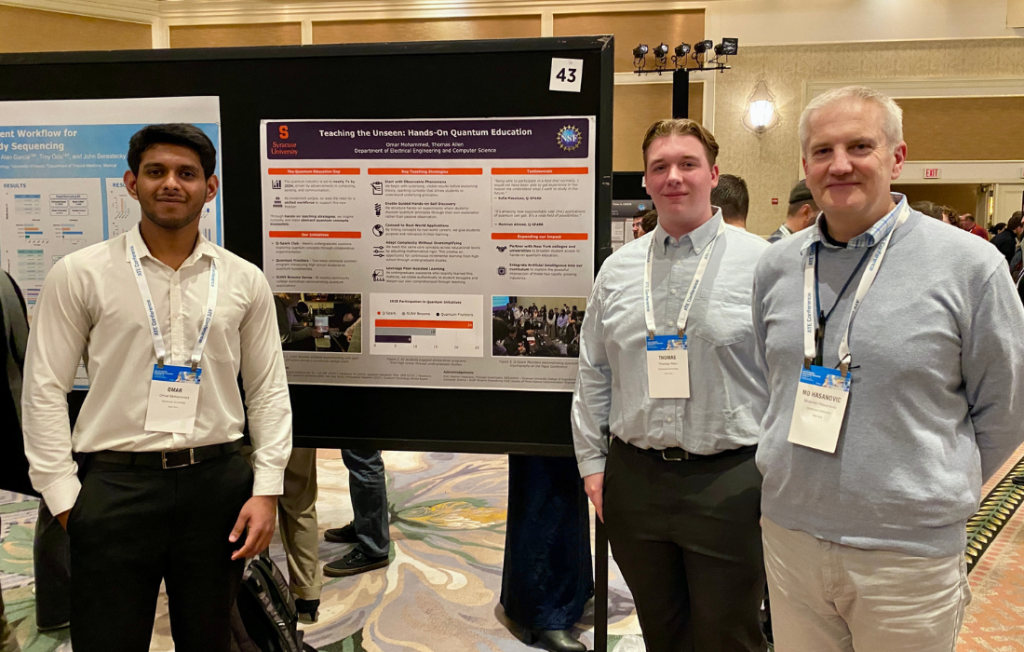
Allen and Mohammed also presented in a student poster session, highlighting their roles in EdQuantum and the student-run club QSPARK on campus. Conference attendees engaged with the students’ hands-on approach and the methodologies used to teach such abstract concepts at the high school and early college levels.
In both sessions, conversations focused on emerging career paths in quantum computing, quantum sensing, and quantum networking, how these fields will shape our future, and why an educated workforce will be essential. The team shared insights from ongoing ECS research and learned about how other universities are engaging with this field.
Beyond EdQuantum, Hasanovic has secured new NSF funding to expand quantum and semiconductor education and outreach. The ATE conference reinforced a clear message: quantum’s future depends on technicians who can turn theory into practice.