
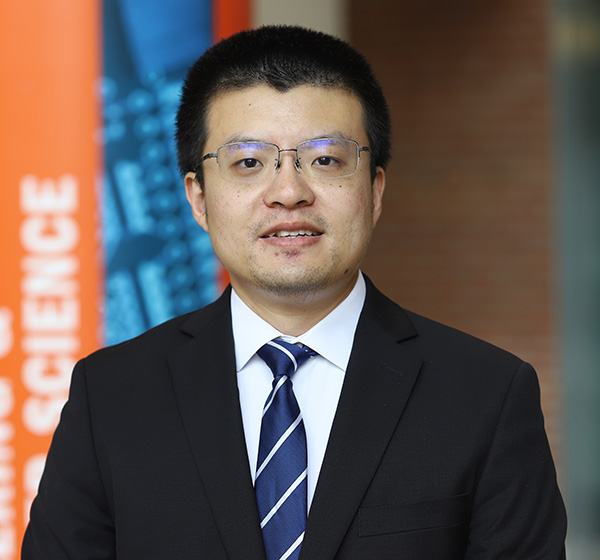
Assistant Professor of Mechanical and Aerospace Engineering Changmin Shi has been awarded a three-year industry grant to develop a manufacturing system for solid electrolyte battery components.
Shi’s project aims to optimize how next-generation batteries are designed and produced using AI tools, with an emphasis on local manufacturing and supply chain security. “We are focused on ‘extreme’ battery design,” says Shi. “We need a solid-state battery that is extremely safe, extremely energy-dense, extremely fast-charging, and extremely cost-effective.”
Most conventional batteries contain a flammable liquid that allows electrical charge to flow between the anode and cathode. But solid-state batteries are gaining attention as safer, energy-efficient alternatives to these flammable counterparts. These batteries can be used in a wide range of applications, including electric vehicles, drones, aviation, and sonar equipment.
Current solid electrolyte manufacturing methods rely heavily on trial-and-error experimentation, requiring a long period of optimization. Shi’s research will use AI to dramatically reduce time to market for these battery components. Shi says that accelerated timeline is critical to meet energy storage needs in the United States and beyond.
“Energy storage demand is projected to grow approximately 70 times over the next 15 years compared to 2019,” explains Shi. “Our efforts align with NYSERDA’s focus on smart, reliable battery technologies and with the goals of New York’s Climate Leadership and Community Protection Act (CLCPA).”
Shi joins a strong ecosystem of ongoing battery research at the Syracuse University, including the Center for Solid-State Electric Power Storage (CEPS), an Industry-University Collaborative Research Center (IUCRC) supported by the National Science Foundation, and Syracuse Center of Excellence in Environmental and Energy Systems (SyracuseCoE). Quinn Qiao, Associate Dean for Research of the College of Engineering and Computer Science, serves as Syracuse University’s site director for CEPS.
“Dr. Shi’s research represents a transformative approach to battery innovation, leveraging AI for more efficient design and lower cost production of solid electrolytes,” says Qiao. “His focus on scalable, US-manufactured solutions directly supports national priorities in energy storage and supply chain security.”
“We are tremendously proud that Dr. Shi’s research is poised to make transformative impacts on battery technology,” says Jianshun “Jensen” Zhang, MAE Interim Department Chair and Executive Director of SyracuseCoE. “His AI-based approach has the potential to revolutionize optimization methodology in battery design by simultaneously advancing multiple critical objectives: safety, energy density, fast charging, and cost-effectiveness.”
Shi joined ECS in August 2025 as an Assistant Professor. He holds a Ph.D. in Materials Science and Engineering from the University of Maryland, College Park, and was previously a Postdoctoral Research Associate at Brown University.