
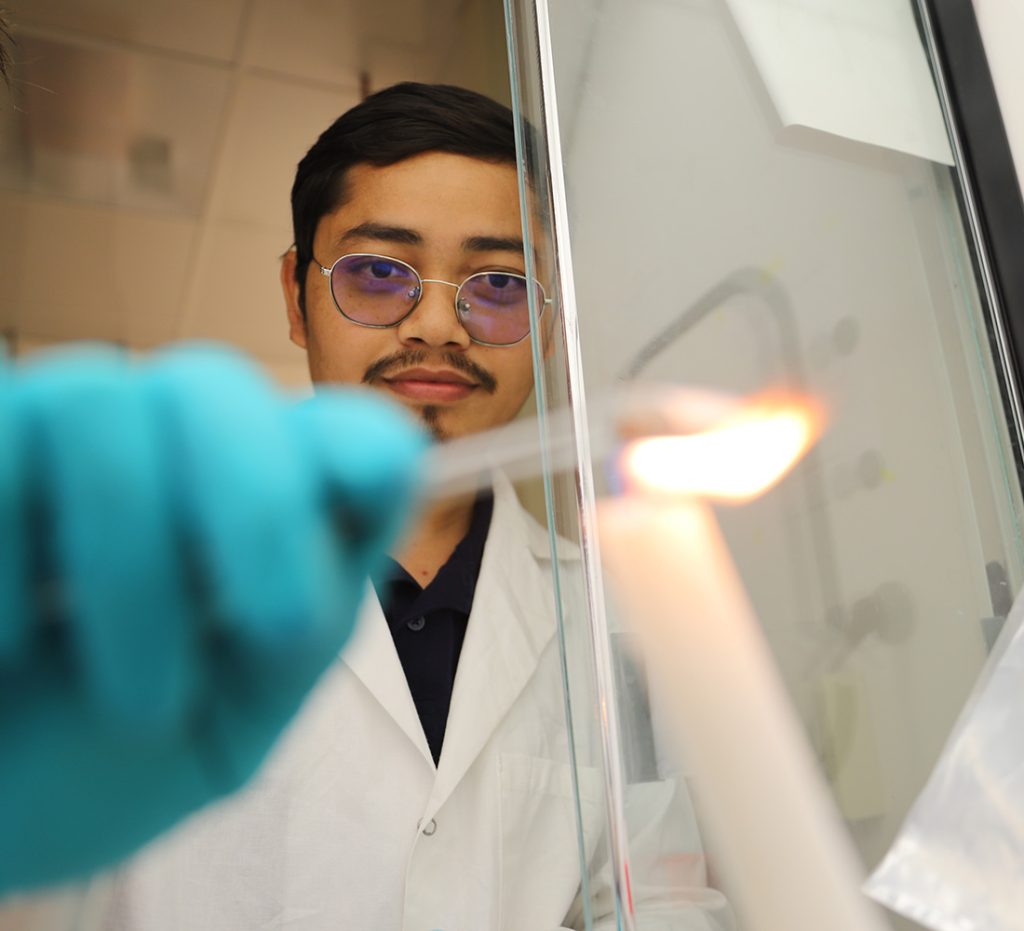
Imagine you are standing on a slippery surface and the slightest imbalance makes you stumble. At Syracuse University, researchers have developed such a surface, not for you (phew!), but for water droplets. Such a super-slippery surface for water, called a superhydrophobic surface, makes water roll-off the surface even if you tilt the surface by just two degrees. Such surfaces can be used for self-cleaning windows, safer medical tools, waterproof clothing, protection of electronics, and even to help ships and planes move faster.
Syracuse University researchers have taken soot coming off a wax candle flame and transformed it into a remarkably durable coating that makes surfaces practically impossible for water to stick to. This invention doesn’t stop at water. It also repels sticky substances like honey and chocolate syrup and even cleans itself from dirt and dust. Unlike other artificially developed water-repelling superhydrophobic coatings, which fail under heat and prolonged exposure to water, the design from Syracuse University proved astonishingly robust. It survived high-speed water jets, chemical baths, saltwater, scorching temperatures up to 650 °F and even a full month submerged underwater, emerging dry and intact.
“The magic comes from a clever combination of candle soot with oil-infused porous silica structure. The porous structure holds the oil which in-turn holds the soot particles making the surface superhydrophobic.” said doctoral student Maheswar Chaudhary, who worked on the project alongside fellow doctoral student Ashok Thapa under the guidance of Mechanical and Aerospace Engineering Professor Shalabh C. Maroo in the College of Engineering and Computer Science. “We have shown this approach to work on both flat and curved surfaces, making it versatile for real-world applications. This isn’t just about repelling water, it’s about creating an easy-to-fabricate coating that truly survives real-world conditions.”
Maroo sees the discovery as a reminder that innovation doesn’t always start with exotic ingredients. “Even something as ordinary as a wax candle can inspire groundbreaking ideas,” he said. “We’ve turned candle soot into science, blending simple materials with simple nanoscale engineering to open up exciting possibilities for technology and sustainability.”
The research was recently published, with open (free) access, in Surfaces and Interfaces.
