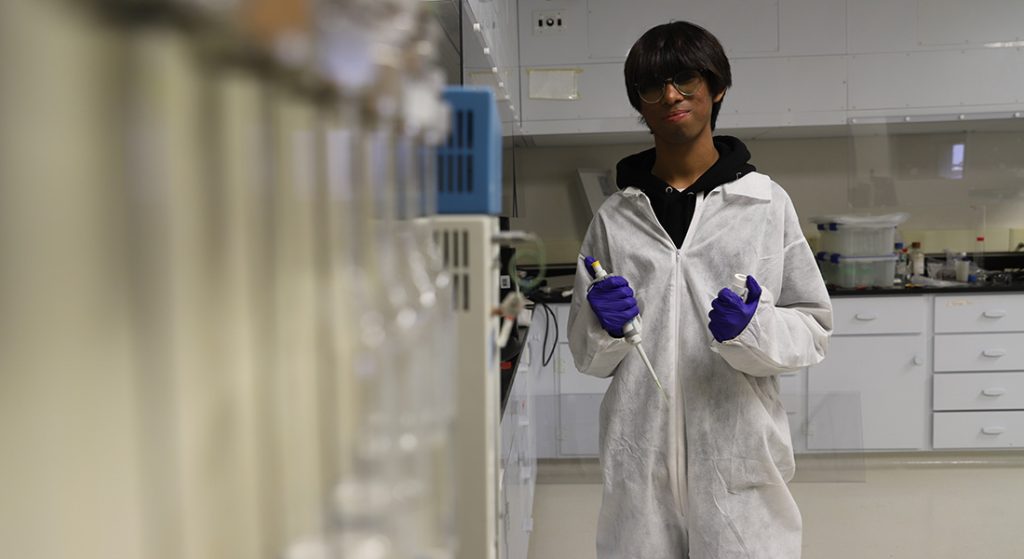
As a first-year student, Charan Jaggena ‘28 casually mentioned in an advising meeting that he wanted to get more involved in on-campus research. Just a few days later, his advisor, Professor Svetoslava Todorova, connected him with lab manager Mario Montesdeoca.
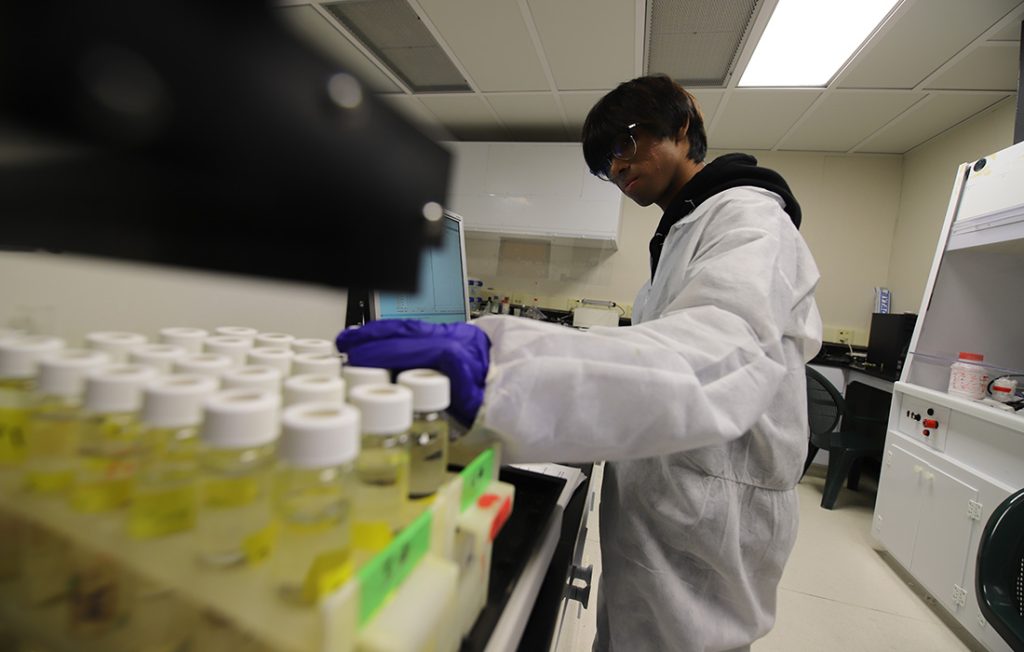
“Once I started working with Mario, I was in the lab from day one,” says Charan. “I got trained in the spring semester and stayed on campus running samples all throughout the summer.”
With Montesdeoca’s help, Jaggena applied for research funding through the Syracuse Office of Undergraduate Research and Creative Engagement (SOURCE). Through his two-year SOURCE fellowship, Jaggena will work with both Professor Aaron Mohammed and Professor Todorova to study mercury contamination in waterways — with a specific focus on Toolik Lake in the northernmost region of Alaska. He will also perform total mercury analysis for water samples collected from Lake Erie.
“My research is on mercury transport — by the end of the fellowship, I’m hoping to produce a paper on how mercury that is trapped in the Alaskan permafrost is thawing because of global warming,” Jaggena explains. When this mercury is released, it can move into nearby waterways, contaminating local water bodies and the surrounding ecosystem. “This type of bioaccumulation can lead to a public health crisis,” says Jaggena.
The urgency of this work became especially evident earlier this year when one of the Toolik Lake sampling sites collapsed. “The permafrost is thawing so fast, it destabilizes the land,” he says. “When a sampling site collapses, we can actually see the permafrost layer, so we can collect a sample of the permafrost itself – and obviously that has the highest concentration of mercury.”
Closer to home, Jaggena’s research with Todorova supports a project to determine how mercury transforms into a more toxic compound during nearshore algal blooms in Lake Erie — a process called methylation. “We are trying to understand how algae can enhance the production of methylated mercury species by establishing microenvironments conducive to this transformation,” explains Todorova.
Beyond technical laboratory skills like learning to operate complex machinery, use data analysis software like R, and maintain rigorous safety protocols, Jaggena has honed his ability to translate lab data into a compelling story. He worked with Montesdeoca to comb through the data they had collected and present the results in a compelling format for the SOURCE Summer Research Symposium.
“That was the most fun part,” Jaggena explains. “It’s like making an album — you have a bunch of songs recorded, and you have to pick the right ones.”
His hands-on work in the lab is reinforced in the classroom: through The Role of Science in Environmental Governance, an honors course taught by Todorova, Jaggena was able to attend the sixth meeting of the Conference of the Parties to the Minamata Convention on Mercury (COP-6) in Geneva, Switzerland.
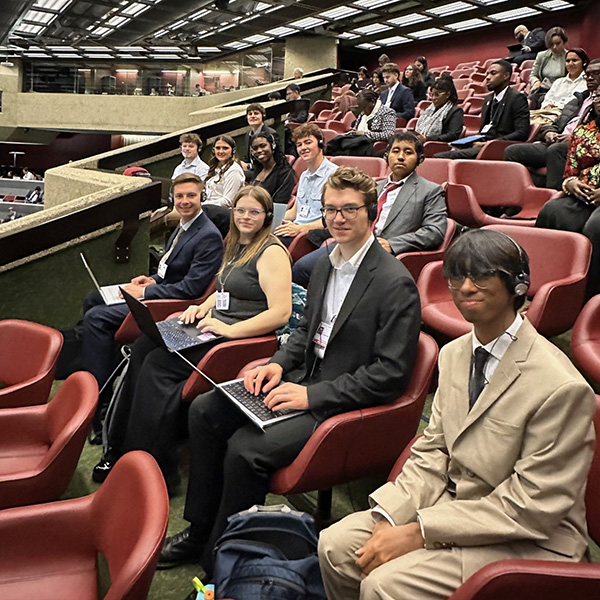
For Jaggena, who is double majoring in Environmental Engineering and Environment, Sustainability and Policy at Maxwell, COP-6 offers the opportunity to see the real-world impacts of mercury research and witness environmental policymaking in action.
Jaggena’s advice to other students considering undergraduate research is straightforward: just ask. “If you’re interested in doing something, voice it,” he says. “There are a lot of people here who really want to help you.”