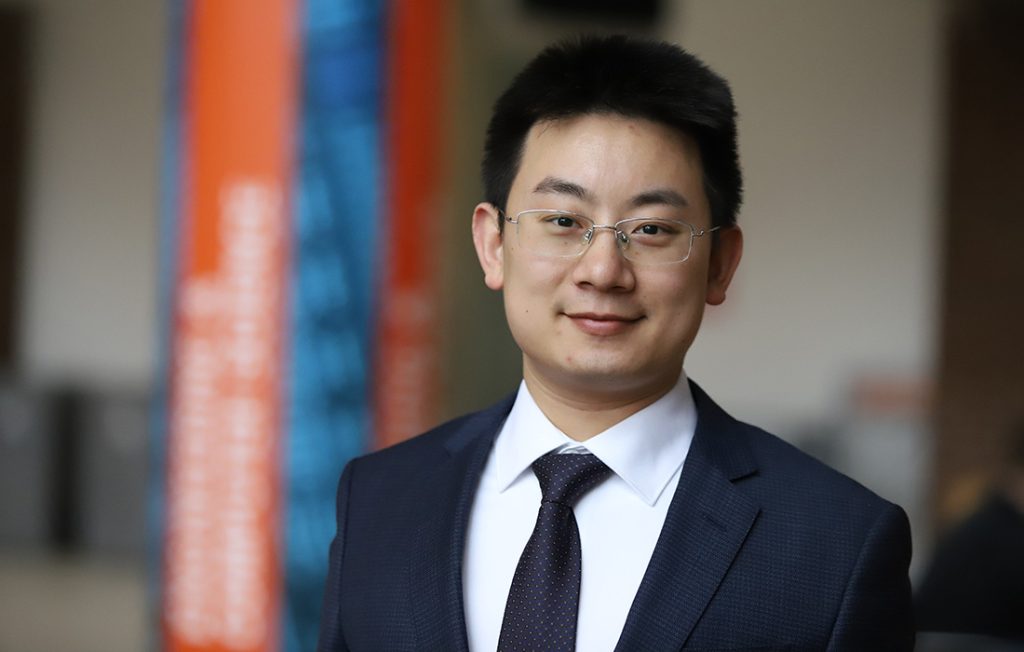
Have you ever seen a horse change from trotting to cantering to galloping? Animals don’t move in one static pattern—they continually adjust their movements and shift their positioning. Mechanical and aerospace engineering professor Zhenyu Gan studies dynamic locomotion and applies it to robotics, asking: What if robots could move like animals?
Gan is the recipient of a 2026 National Science Foundation (NSF) Faculty Early Career Development (CAREER) Program award. This highly competitive program supports faculty in the early stages of their academic careers as both teachers and researchers. The College of Engineering and Computer Science (ECS) has a strong track record of NSF recognition, with ten faculty receiving the CAREER award in the past five years.
Current designs for legged robots are often limited to pre-programmed movements or are designed for a single task. Gan’s research project will study how animals transition seamlessly between different movement patterns in response to their environment and apply these principles to robotic systems. Specifically, the project will focus on developing Transformable Legged Robots (TLRs)—robots that can adjust their physical form to enhance mobility, energy efficiency, and multi-tasking capabilities.
“Animals do not rely on a single body shape or movement pattern. They adapt their form and coordination as tasks and environments change,” explains Gan. “This project aims to give robots that same kind of physical intelligence. By treating a robot’s shape as part of the dynamical system rather than a fixed design choice, we can build machines that are more energy-efficient, more versatile, and better suited for real-world tasks such as search and rescue, manufacturing, and mobility in complex environments.”
Gan’s framework introduces three integrated approaches. First, he will construct a general modeling framework for variable morphology, including symbolic representations of form and symmetry-based model reduction. Second, his team will characterize the relationship between form and function through trajectory optimization and bifurcation analysis, generating a library of task-optimal shapes and motions. Third, they will develop a hierarchical control strategy that allows robots to change their movements in response to specific tasks or environmental factors.
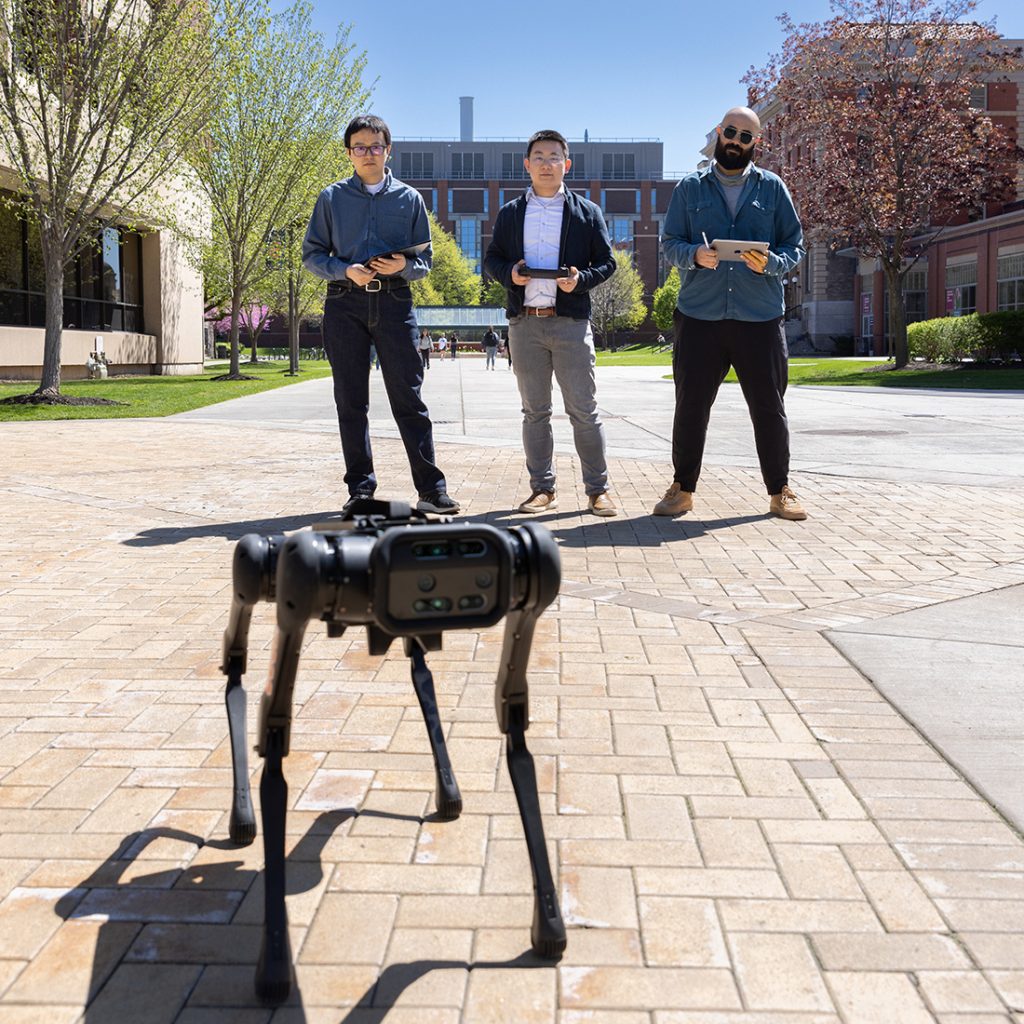
The NSF project builds on Gan’s previous research on bipedal and quadrupedal locomotion, gait analysis, and trajectory optimization. At ECS, Gan leads the Dynamic Locomotion and Robotics Lab, where he and his students have studied movements of animals including horses, sled dogs, and jerboas—a type of rodent that moves by hopping on its back legs. For example, a sled dog might adjust its gait depending on how much weight it is pulling. Gan’s team can study these movement patterns and create a modeling framework to apply to legged robotic systems.
“Dr. Gan’s CAREER Award highlights the strength and originality of his research vision, which seamlessly connects foundational advances in dynamics and control with high-impact applications in robotics,” says ECS Interim Associate Dean for Research Quinn Qiao. “His pioneering work on transformable legged robots exemplifies the forward-looking, interdisciplinary research we champion in the College of Engineering and Computer Science. By integrating theory, experimentation, and education, Dr. Gan is not only pushing the boundaries of robotics but also creating rich, hands-on learning experiences for students at every level.”
In addition to NSF support, Gan’s research is further strengthened by industry investment. He has received an academic grant from NVIDIA to support related work on edge AI and autonomous multi-robot systems. The award provides access to advanced GPU computing resources and embedded AI platforms, enabling large-scale simulation, learning-based control, and real-time robotic perception. This support complements Gan’s CAREER project by accelerating data-driven experimentation and broadening the computational foundation of Gan’s robotics research.
As a CAREER awardee, Gan will also develop integrated educational programming for K-12, undergraduate, and graduate students. Middle school students will assemble and program quadrupedal robots, exploring how leg morphology affects locomotion through a soccer challenge. High school students will participate in autonomous navigation workshops culminating in a racecar Grand Prix. This tiered programming also includes mentorship: undergraduates will support the high school racecar program, while high school participants will serve as peer tutors for middle school students. Ultimately, Gan hopes this mentoring structure will create a pipeline for students to build core competencies in robotics and ignite curiosity in STEM learning.
“The NSF CAREER Award not only recognizes outstanding research promise, but also a commitment to training the next generation of engineers. Professor Gan’s work on robotics is a perfect gateway to spark the interest of young learners and get them excited about the promise of robotics to build the future,” says Interim Dean of the College of Engineering and Computer Science, Jennifer Ross.
Gan has been a faculty member at Syracuse University since 2020. Prior to his appointment at ECS, he completed postdoctoral research at the University of Michigan, where he earned both an M.S. and Ph.D. in mechanical engineering. In addition to leading the DLAR lab, Gan serves as a Senior Research Associate with the Autonomous Systems Policy Institute and the Form & Function Focus Group Leader for the BioInspired Institute.