
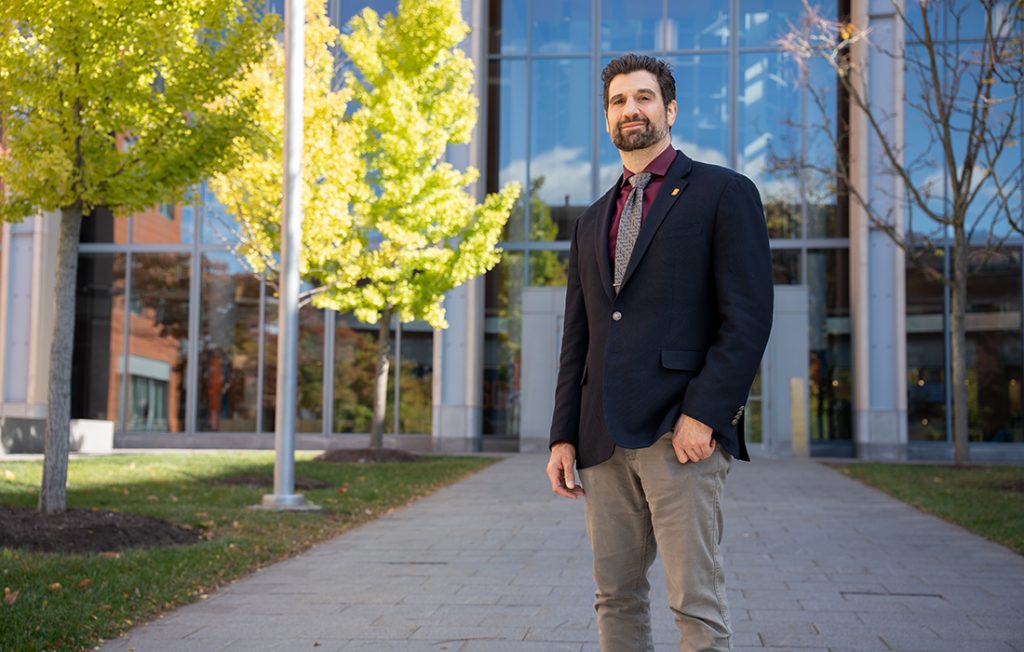
Electrical Engineering and Computer Science Professor Paulo Shakarian will work on a research project to improve cybersecurity in healthcare facilities. Professor Shakarian is part of a team, led by HRL Laboratories, that received an award from the Advanced Research Projects Agency for Health (ARPA-H) Universal PatchinG and Remediation for Autonomous DEfense (UPGRADE) program.
The UPGRADE program aims to develop cybersecurity platforms that protect hospital operations in the event of a ransomware attack. “The UPGRADE program is filling a key need for hospitals,” said Shakarian. He previously worked on cyberattack prediction through programs including IARPA CAUSE. “Hospitals have a unique attack surface that includes a variety of interconnected medical devices,” Shakarian explains. “Furthermore, these devices are often critical for patient care, so hospitals must balance security with operational needs.”
Hospitals and other healthcare facilities are uniquely vulnerable to cyberattacks: not only are they responsible for safeguarding patients’ protected health information (PHI), but they must also maintain an extensive network of internet-connected medical equipment. Cybersecurity threat detection and remediation must be efficient and reliable to ensure there are no interruptions to patient care.
The HRL Laboratories project will focus specifically on auto-detecting software vulnerabilities by uncovering the thought patterns of hackers. The team will use an open-source software program called PyReason, created by Shakarian’s lab, that will integrate hacker cognitive models with cybersecurity domain knowledge. “I believe our colleagues for this project will provide top-tier cognitive models to emulate hackers,” Shakarian says. “Our job is to ensure that the output of these models aligns with well-known domain knowledge concerning the discovery of vulnerabilities.”
PyReason will uncover and resolve inconsistencies in logic from cognitive models. Ultimately, the team will contribute to a smarter software solution that can predict cybersecurity threats and fix vulnerabilities before attacks occur.
“Professor Shakarian’s work represents exactly the kind of high-impact collaboration with world-class partners like HRL Laboratories, supported by ARPA-H, that strengthens our place as a national leader in AI,” said Alex K. Jones, Professor and Chair of Electrical Engineering and Computer Science. “By leveraging AI to defend against cyber threats, his team is addressing one of the most critical challenges of our time – protecting patients and hospital systems without disrupting care.”
Based in California, HRL Laboratories is a research and development company owned by General Motors Corporation and Boeing. HRL Laboratories works on a wide range of scientific technologies, from sensors and photonics to microsystems and advanced materials, and holds over 1,100 patents.
Paulo Shakarian joined the College of Engineering and Computer Science in summer 2025 as the first appointed K.G. Tan Professor of Artificial Intelligence. He directs the Leibniz Lab, which advances research in neurosymbolic AI, temporal logic programming, and metacognition. Prior to his appointment at Syracuse University, Shakarian was Research Director and a tenured faculty member in the School of Computing and AI at Arizona State University.
For more information on ARPA-H, visit arpa-h.gov.