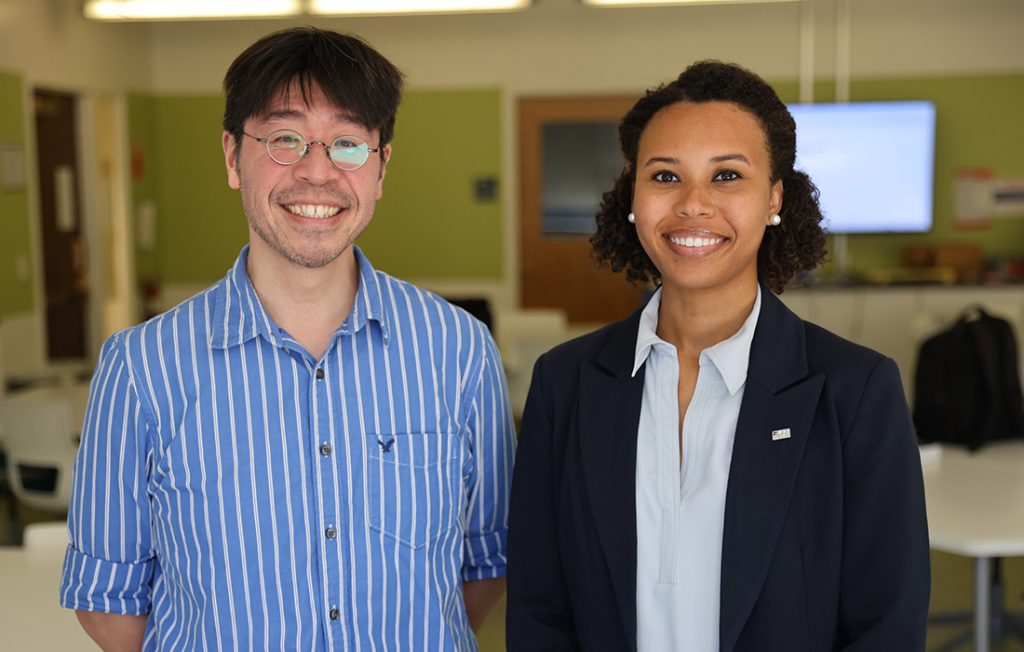
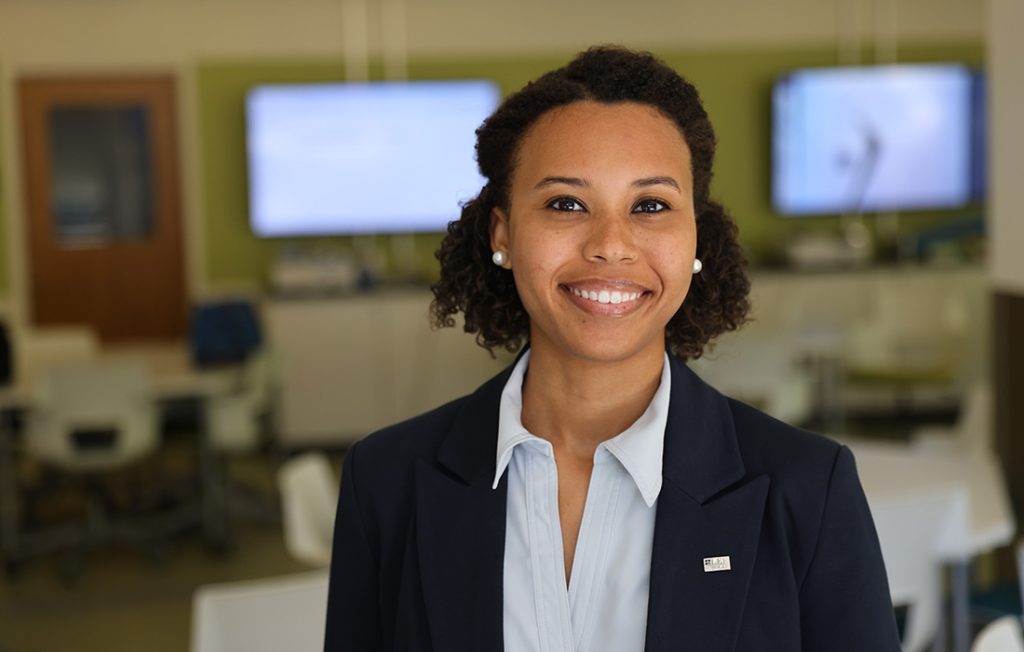
Biomedical engineering alum Jade Carter ’24 is currently a second year master’s student in motor learning at Teacher’s College, Columbia University. Her career goal is to become an engineer who designs rehabilitation equipment to improve mobility and independence for individuals with neurological conditions. When she was at Syracuse University, Carter was an active member of the Biomedical Engineering Society, the National Society of Black Engineers and was selected as a Distinguished Lee Scholar by the Patrick P. Lee foundation.
We were able to catch up with her when she recently returned to the Syracuse University campus to speak to the Fall 2025 Convening of Lee Scholars.
What drew you to biomedical engineering initially?
I was first drawn to biomedical engineering after my grandmother suffered a fall that left her with a broken ankle. She played a pivotal role in raising me, and watching her go through a slow, painful recovery as a type 2 diabetic was incredibly challenging. Watching someone who once cared for me now struggle with her own independence was difficult. That experience sparked a desire in me to help others regain their mobility and improve their overall quality of life. I’ve always loved problem-solving, and biomedical engineering felt like the perfect way to turn that passion into something meaningful.
What were some of the most impactful courses or projects during your time in the College of Engineering and Computer Science?
One of the most impactful courses I took was the Senior Capstone Design course through the Biomedical and Chemical Engineering Department. This year-long experience allowed me to go through the entire design process in a simulated start-up environment from identifying a problem to developing a final prototype with my team. It was incredibly rewarding to apply the technical skills I had developed over the previous three years to a project I was passionate about. My team created a platform that used markerless motion capture technology to automatically calculate lower limb joint angles from uploaded videos of someone walking. The goal of this project was to reduce the time, cost and equipment required for gait analysis so it is more accessible for clinicians to use in their clinics to support children with cerebral palsy. Another one of my favorite courses was Sports Engineering. I grew up playing soccer and competing in track and field, so I’ve always loved sports and been fascinated by how the body moves. This class made it fun to connect what I was learning in physics and engineering to real world concepts, like analyzing baseball pitching mechanics and exploring the intricate design behind running footwear. I also had the chance to help Dr. Cindy Smith develop the curriculum for Syracuse University’s first STEM of Sports Academy in the summer of 2024. We designed hands-on activities to teach high school students about STEM concepts through the lens of sports.
What are some ways that the Lee Foundation’s support made an impact on your academic journey?
The Lee Foundation’s support has had such a tremendous impact on both my academic and personal journey. Being named the 2024 Distinguished Lee Scholar allowed me to graduate from Syracuse with minimal debt. In addition to that, the Foundation has given me a community of mentors and peers who truly want me to succeed and continue to support me now as a graduate student at Columbia University. Mr. Lee’s generosity and his commitment to paying it forward inspires me to do the same for the next generation of engineers and entrepreneurs.
How did Syracuse University prepare you for your current career path?
I really appreciated that my program encouraged students to take courses outside of the College of Engineering and Computer Science that aligned directly with our career interests. I took several courses through the Exercise Science Department, which enhanced my understanding of human movement from a physiological perspective and helped me become a more well-rounded engineer. I also had the opportunity to get involved in research early on, working as an undergraduate research assistant in the Bionics, Systems, and Control Lab during my last three years at Syracuse. In the lab, I helped develop and test a robotic ankle device designed to improve walking performance for stroke survivors. This experience combined my love for problem solving with my desire to help others, and it was instrumental in building the skills I use today as a Graduate Research Assistant in the Neurorehabilitation Research Lab at Teachers College, Columbia University.
What skills (technical or soft skills) that you developed at Syracuse University have been most valuable in your career?
Syracuse University gave me a strong foundation in technical skills essential to biomedical engineering, but more importantly, I developed the ability to adapt those skills in new situations. I didn’t graduate knowing all the answers, but I left knowing how to approach any problem with the tools I need to be successful. Just as important, I gained experience communicating ideas clearly and collaborating within interdisciplinary teams- which I use every day being in my research lab working alongside physical therapists, neuroscientists and exercise scientists. I’ve learned that even the most innovative ideas can’t make a difference if they aren’t communicated effectively.
Are there any mentors or experiences from your time as a student that still influence you today?
One mentor who continues to influence me today is my former professor and advisor, Dr. Douglas Yung. I took many courses with him over the years, and he consistently challenged me to think critically while encouraging a human-centered approach to engineering. He reminded me that as biomedical engineers, our role is to design solutions that serve the broader community of clinicians, healthcare workers, and patients alike. That perspective continues to shape how I approach my work every day.