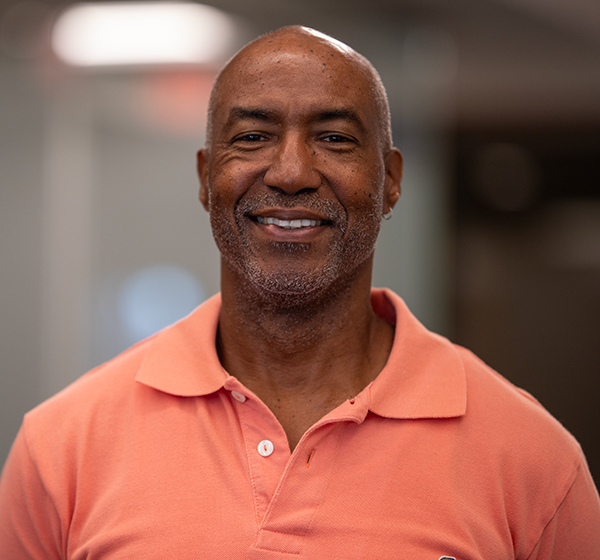
Before he even knew he wanted to be an engineer, Steve Harvey ’91 was applying his aptitude for problem-solving to figure out his own path to college. Despite solid grades and a desire to learn, Harvey’s high school guidance counselor suggested he wasn’t college material. It was a formative moment at the onset of his career journey, and it became a driving force that led him to Syracuse University as a first-generation student, where he graduated with a bachelor’s degree in electrical engineering and a minor in mathematics.
“Even as a non-traditional student, there are a lot of opportunities out there that you may not be aware of, but when you have the right connections and the right exposure, it can come to life for you,” says Harvey.
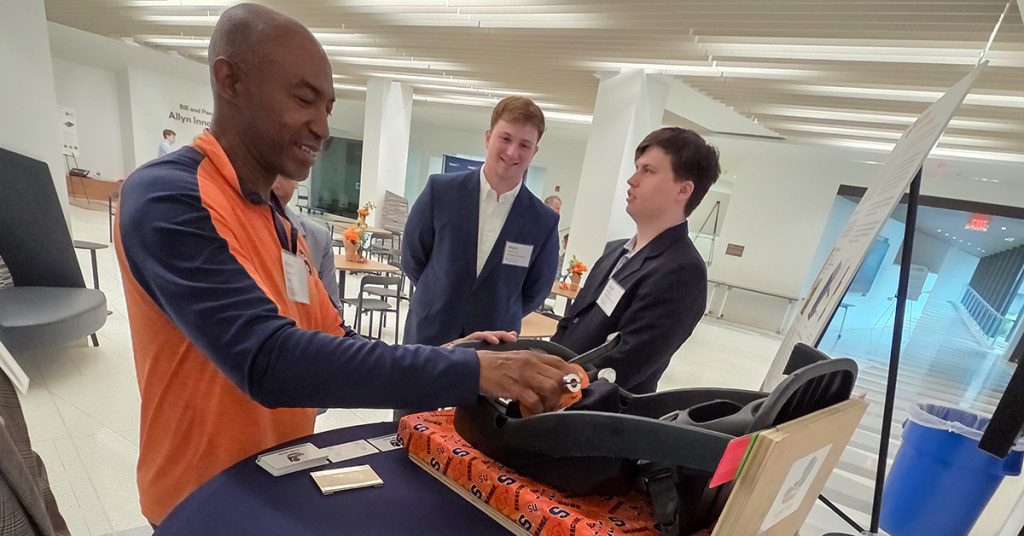
Harvey, now retired after a successful career in telecommunications, recently returned to campus, drawing on his early experiences to mentor a new generation of innovators. During the summer of 2025, Harvey participated as a judge for Invent@SU, a program that challenges students to design, prototype, and pitch an original invention in only six weeks. Harvey observed it’s a hands-on, collaborative experience that not only accelerates student development in technical areas, but also around key accessory skills like communication and presenting. Something he says could have been beneficial during his time in college.
“It would have made me a little bit more comfortable. I think every engineering student would benefit,” says Harvey. “I would love to participate again. There were some really good projects.”
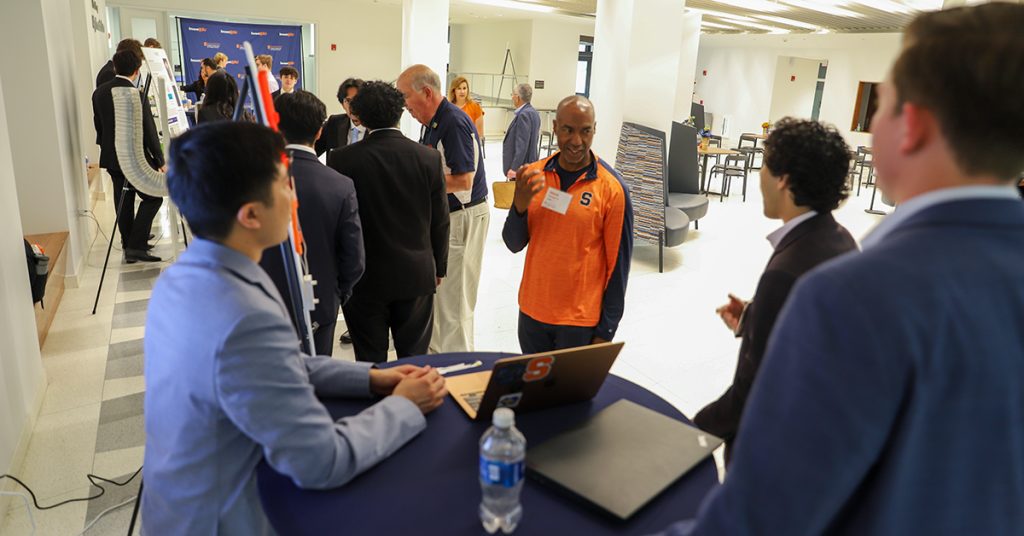
Lacking guidance and mentorship, after high school, Harvey joined the military, and he immediately received a strong evaluation for his abilities in science and math. He also developed a strong sense of discipline that would become the cornerstone of his skillset. Following nearly a decade on active duty as a radar tech, Harvey entered the reserves and obtained a job at General Electric in Syracuse, NY, as an engineering system test technician. In contrast to his experience in high school, his commanders in the military pushed him to succeed, and the experience ignited an early insight into the value of leadership and mentorship.
“It was a profound influence because now I felt like someone really cared about me, saw the potential that I had, and wanted to foster and mentor it,” says Harvey.
By chance, another member of Harvey’s unit graduated from Syracuse University and recommended he apply. The drive and discipline that brought Harvey to the University were directed toward achieving his degree while continuing to work his full-time job. His mission-based approach helped him focus on reaching his goals and managing a packed schedule, but he says it came at a cost.
“Being so driven and so focused, I didn’t build the connections I should have built,” says Harvey.
Harvey didn’t completely understand the importance of community and networking. It’s a common challenge and a significant disparity in the college experience of a first-generation student. Looking back, Harvey believes resources that aid these students in identifying blind spots and enable them to focus on academics would make a life-changing difference.
“Having that person to guide them, letting them know what the pitfalls are, and letting them know the things they really need to concentrate on, they really need someone to guide them,” says Harvey.
Harvey found mentorship as a member of NSBE (National Society of Black Engineers). Leaders for NSBE helped him make connections with recruiters that led to multiple job offers, including one he accepted from Lockheed Martin. The position pushed Harvey to expand his skills by developing his programming abilities and introducing him to coding techniques and different types of databases. Despite coming into the role without much experience in either area, Harvey’s electrical engineering background proved he could learn, innovate, and problem solve.
“Having an engineering degree, as soon as I got to Lockheed, I was given more and more opportunities because they knew I had that foundation.” says Harvey. “It built on top of what I learned at Syracuse University.”
The experience at Lockheed Martin launched Harvey into telecommunications. He transitioned to Motorola and eventually AT&T, where he rooted his career in transmitting, encrypting, and securing data. It was an exciting time because it placed Harvey at the forefront of the data revolution that led to the arrival of new technologies that are reshaping the world today. For aspiring engineers and computer scientists, Harvey emphasizes that data is just getting started.
“If I was an engineering student now, I would concentrate on all forms of data. Data is the future. Data is going to drive everything,” says Harvey. “If you can master different techniques like how it’s stored, analyzed, transmitted, and secured, that will probably be a big focus.”
First-generation students arriving at Syracuse University today find considerably more resources, but barriers remain. The College of Engineering and Computer Science is committed to providing a supportive environment where every student can thrive while receiving a world-class education that can change their life. For non-traditional students unsure of how to forge a path to higher education, Harvey says the first step is self-assurance, to believe in your ability to navigate uncertainty and to have the courage to discover and take advantage of opportunities.
“Don’t sell yourself short. Even though someone might tell you when you’re young that you’re not college material, but if you feel that you are and you want to do it, listen to what you’re saying inside.”