
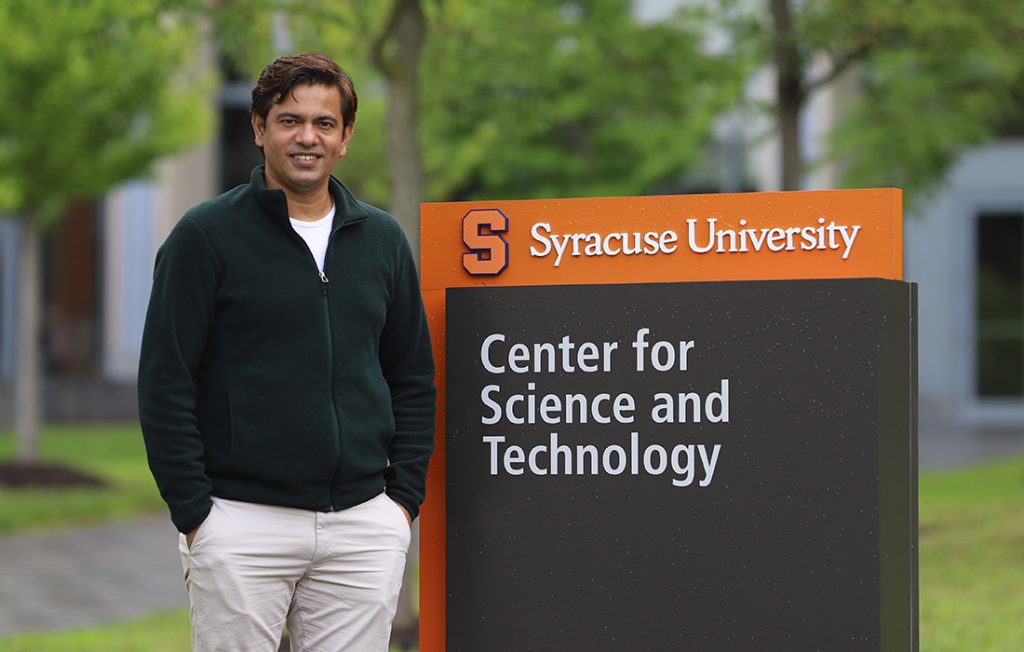
Electrical Engineering and Computer Science Professor Pankaj Jha has received a grant from the United States Air Force Research Laboratory (AFRL) to develop an absorptive atomic resonance filter (ARF) that can detect weak optical signals even in the presence of strong background (thermal/optical) noise. The filters that Jha will develop will have a sub-100 megahertz bandwidth, be electrically tunable across the sub-terahertz range, and provide sub-gigahertz speed.
An absorptive ARF is a type of filter in which a material strongly absorbs a narrow band of light, such as light resonant with an atomic transition. This absorbed light is then re-emitted at a longer wavelength, and by monitoring this re-emitted light, an ARF can separate weak optical signals from a large background.
In contrast to previous atomic filters, Jha and his team will use “atom-like” quantum defects, also known as color centers, in 2D materials. In general, defects are considered harmful to materials and device performance; however, certain defects, such as missing atoms (vacancies) at lattice sites or impurities, can be used to emit or absorb light at specific frequencies. Jha will use color centers in boron nitride, which has emerged as a promising candidate for quantum light emission, to build this filter.
“Good emitters can make good absorbers. Leveraging these color centers to detect background-limited weak optical signals adds another dimension to the exciting world of boron nitride,” Jha says.