
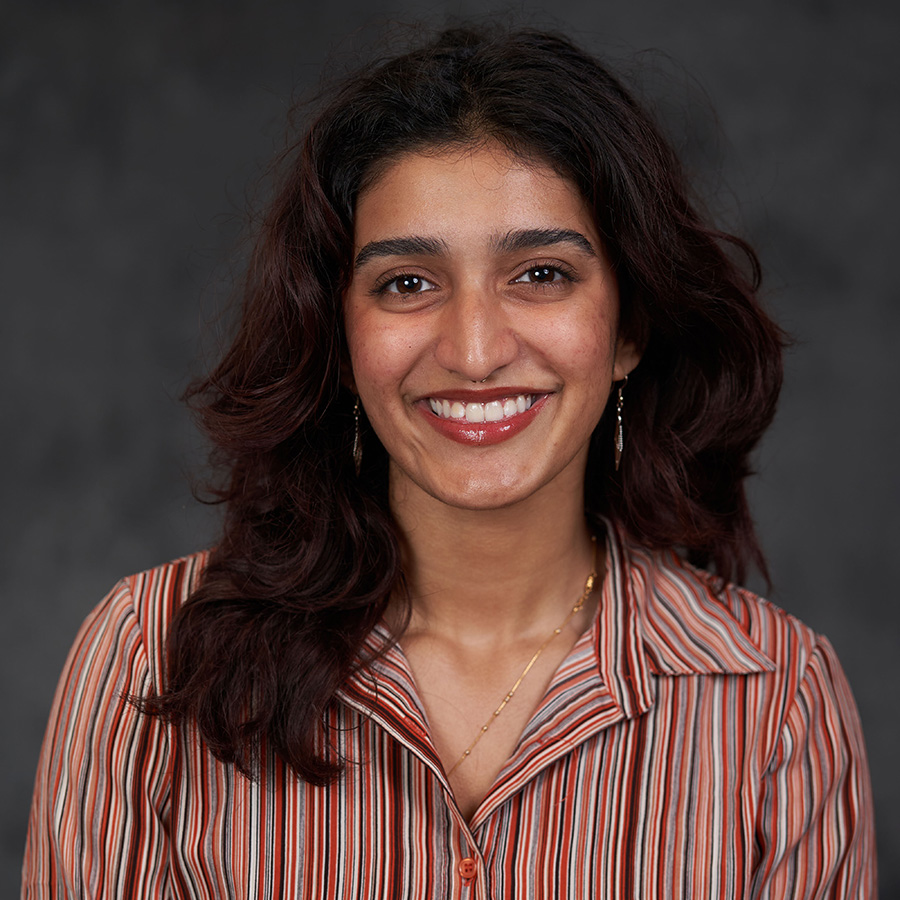
Ananya Chandra’s academic journey demonstrates her commitment to engineering that makes a lasting impact (Chandra uses both she/they pronouns). In the summer of 2023, they interned at Haley & Aldrich, an engineering and environmental consulting firm, where she visited local communities to promote cleanups, conducted soil tests, and used environmental justice mapping tools. She also connected with leaders to support innovative cleanup designs.
Chandra attended the Minamata Convention on Mercury in Geneva, Switzerland, as part of a class trip, where she gained insights into international climate negotiations and the role of academia in building consensus for global thresholds.
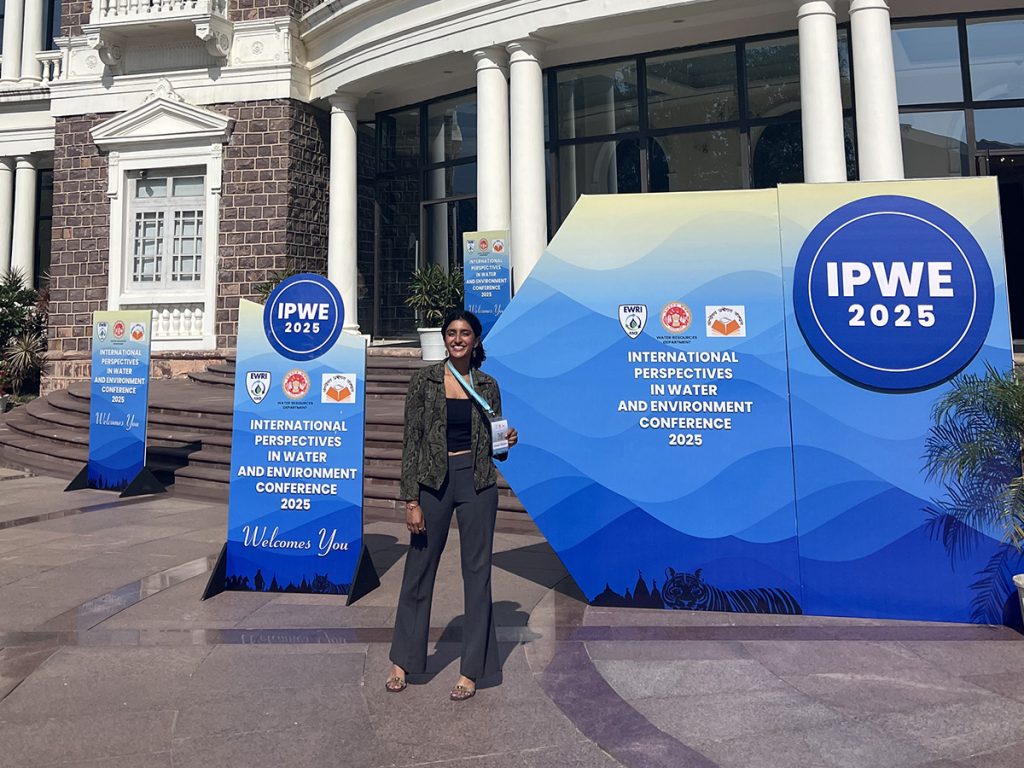
They have also worked with the US Forest Service, the Climate Hazards Research Team at SU, and FEMA (the Federal Emergency Management Agency). She was a member of the American Society of Civil Engineers (ASCE), an alum of Young Voices of Science, and has authored articles for the American Indian Foundation (AIF) on environmental livelihoods and sustainable water infrastructure.
Chandra has also been recognized for her strong academics and has held leadership roles across Syracuse University. Currently, she is a BIF Fellow at the Nehru Foundation for Development, VIKSAT in Ahmedabad, Gujarat, where she researches and documents climate-smart agriculture practices in dry areas in India and other countries. Her work has culminated in a climate-smart agriculture manual pending publication. In this one-on-one interview, Chandra discusses her research interests, experience in the environmental engineering program, and her career path.
Tell us about yourself!
I was a dual major at Syracuse University, so I was enrolled in the College of Engineering and Computer Science and the Maxwell School of Citizenship and Public Affairs. I studied environmental engineering and environment, sustainability, and policy, and I’m a very social science-oriented STEM person. I was also in the honors program, and my thesis was in geography. I love art, trying new recipes, and spending time outside.
What sparked your interest in coming to Syracuse University?
I was a Coronat Scholar! It was an incredible opportunity I couldn’t give up. It’s four years of tuition, funded research and study abroad, and Syracuse was a place that was big enough for me to explore options.
What do you enjoy about environmental engineering?
I love how you can tangibly see the impact of your work. As a hands-on person, that means a lot to me. I was a research assistant with professors Chris Johnson and Liz Carter. One thing I’m thankful for at Syracuse University is its diverse array of experiences and resources. Just by showing interest and speaking to people, a conversation often led me to an exciting opportunity.
What are your research interests?
My research focus presently is climate-smart agriculture, an approach to making farming sustainable and resilient in the face of climate change. I’m also interested in water infrastructure and the policy side of engineering. I took Professor Svetla Todorova’s course titled “Role of Science in Environmental Governance” and attended the COP-5 of the Minamata Convention on Mercury as an academic ambassador.
Broadly, I’m passionate about water systems and making them accessible to all, as well as improving water infrastructure. As engineers, a lot of our work is humanity-facing infrastructure, which inherently impacts marginalized communities, so I’m interested in how we can do better.
What was your experience in the environmental engineering program like?
Professors go the extra mile to give experiential learning. We used local data in research and in our environmental chemistry lab, such as samples from Onondaga Creek. I switched into engineering after my freshman year, only after understanding at Syracuse University how diverse the field is.
Where do you see yourself in the future?
I would enjoy being at the intersection of policy and engineering. I like engineering roles where I can integrate the social impacts of our work, and I’m really enjoying doing things locally in my current role. I see myself continuing this and working in a place that allows me to engage with communities regularly. In the future, I want to work specifically in urban climate resilience, equipping cities with the infrastructure to withstand the impacts of climate change.
Also, doing high-level engineering while interweaving social impacts in my work. I’m really interested in the participatory processes, how we can work with communities to design projects, and how it can function for their needs.
Do you have any advice for students?
I would tell students to approach networking with curiosity about what opportunities could look like and what the landscape of their field will look like in the future. Even if it’s a conversation that results in you realizing you don’t want to do something, it can be useful. I think you can learn the most from people and their experiences!