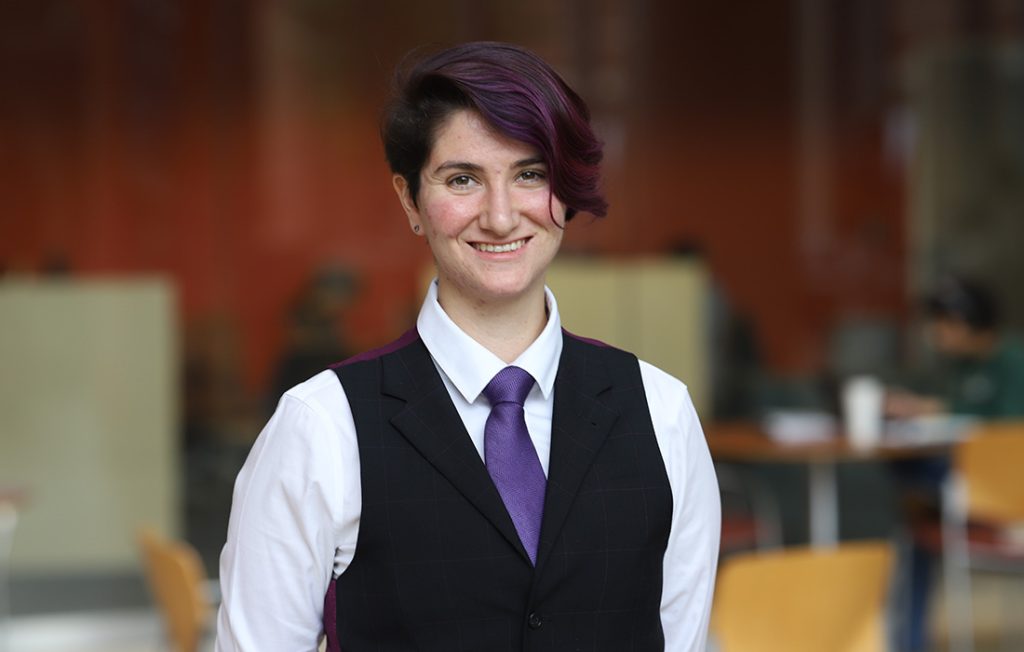
Motivated by a passion for understanding how the brain learns, Chloe Britton Naime ’25 aspires to become a neuroscientist. As a child of engineers, they were naturally exposed to the field from an early age. However, for a young Britton Naime, the world of engineering seemed far less interesting than the complexities of the human brain, a belief that was held until late high school.
“I took a course in calculus and physics and realized I like engineering much more than I expected,” says Britton Naime.
Unwilling to abandon their love of neuroscience, Britton Naime pursued a dual major at Syracuse University, enrolling in both mechanical engineering at the College of Engineering and Computer Science and neuroscience at the College of Arts and Sciences. This dual major was an ambitious approach, combining two fields that seem unrelated on the surface, but Britton Naime was determined to make it work.
As an undergraduate research assistant at the Center for Autism Research and Electrophysiology (C.A.R.E. Lab), directed by Natalie Russo, Ph.D., their research focus was on identifying and understanding sensory and perceptual differences within autism and related conditions in children and adults. Additionally, Britton Naime was a peer coach at Syracuse University and a Fulbright-Mitacs Globalink scholar as a research assistant at the University of British Columbia’s Baby Learning Lab (B.L.L.), directed by Lauren Emberson, Ph.D.
“My experience at the University of British Columbia focused on understanding underlying mechanisms of learning in infants using a neuroimaging technique called functional near-infrared spectroscopy (fNIRS),” says Britton Naime. “I was central in developing the lab’s first data preprocessing pipeline for their state-of-the-art high-density fNIRS system.”
Though being a dual major student in neuroscience and mechanical engineering was challenging, Britton Naime stayed on top of their work and completed their neuroscience honors thesis and mechanical engineering capstone project. With their capstone group, they designed, built, and tested an innovative energy storage device that utilizes elastic potential energy through rubber balls.
“Collecting data and understanding different methods used in neuroscience has been aided by my work in mechanical engineering – allowing me to analyze and understand the complexities of processing neuroimaging data,” Britton Naime says. “Mechanical engineering allowed me to use the systematic and efficiency part of my brain.”
Britton Naime has also been the recipient of scholarships and awards, including Scholarship in Action, the Invest in Success Scholarship, and the SU Orange Distinction Award, among other achievements. Graduating from the University in the spring of 2025, they look forward to working toward a PhD in neuroscience at Florida State University, where they will continue their research on how the human brain learns.
“I would like to thank Dr. Natalie Russo, Dr. Lauren Emberson, the C.A.R.E. Lab, and B.L.L. for all their support and mentorship. I’m grateful for the Career Center, especially Shelby Bergen, who has been a big supporter,” says Britton Naime.
“I’d like to thank Dr. Michelle Blum, Dr. Mehmet Sairmurat, and Dr. Jen Cook, who have been essential in helping me stay on track to graduate in four years with my majors,” Britton Naime continues. “I’d also like to thank Jolynn Parker, who specifically helped me with my Fulbright-Mitacs application, and S.O.U.R.C.E. and the Honors College for providing funding for an independent research project I completed in the C.A.R.E. Lab.”