
Picture a cold January night in Syracuse. The wind chill is well below zero, the snow is horizontal, and inside, a home stays a comfortable 70 degrees—heated entirely without oil or natural gas. No furnace. No flame. Just physics.
That is not a future scenario. It is happening right now across Upstate New York, and Ian M. Shapiro, Professor of Practice in the Department of Mechanical and Aerospace Engineering at Syracuse University’s College of Engineering and Computer Science (ECS), is one of the leading researchers working to make clean heat the norm rather than the exception.
Through a portfolio of sponsored research projects, Shapiro and his team are elevating heat pump technology to new heights of efficiency—lowering energy costs for homeowners, reducing the carbon footprint of buildings, and helping New York State chart a cleaner energy future.
The Science Behind Heat Pumps
The way a heat pump works, Shapiro admits, can be difficult to explain. Unlike a gas furnace that generates heat by burning fuel, a heat pump moves heat from one place to another—extracting thermal energy from the outdoor air and transferring it inside a building.
“If you take an ice tray outdoors when it’s 40 degrees outside, the ice at 32 degrees is colder than the air, so the heat from that 40-degree air melts the ice,” Shapiro explains. “That’s basically what we’re doing with a heat pump: we circulate a very cold refrigerant outdoors, that refrigerant absorbs heat, and then we pump that heat up to a high pressure and we move it indoors.”
One of the most persistent myths about heat pumps is that they do not work well in places with cold, snowy winters like Central New York. That’s simply not true with today’s heat pump models, says Shapiro. “Newer heat pumps can speed up when it’s cold outside, just like putting your foot on the accelerator of your car. We have thousands of heat pump units working successfully without any backup heat in buildings across Upstate New York.”
A Portfolio of Innovative Research
Shapiro is currently overseeing several major heat pump research projects, working closely with ECS faculty Bing Dong and Jianshun “Jensen” Zhang. All three serve in leadership roles at Syracuse Center of Excellence in Environmental and Energy Systems (SyracuseCoE), where Zhang is Executive Director, Dong is Co-Director, and Shapiro is Associate Director of Building Science and Community Programs.
Shapiro is Principal Investigator for one of just nine teams selected nationwide for the U.S. Department of Energy’s prestigious Building America program. His team’s project, “Reducing Applied Losses in Heat Pumps,” focuses on identifying and reducing the inefficiencies that negatively affect heat pump performance. Working in partnership with the Association for Energy Affordability, Shapiro is retrofitting homes in Syracuse’s historic 15th Ward.
This spring, Shapiro started a new project, “Transforming Heat Pump Performance for a Low-Carbon Grid,” supported by the New York State Energy Research and Development Authority (NYSERDA). This will build on his previous research on applied losses, with the ambitious goal of demonstrating that a Coefficient of Performance (COP) of 4.0 is achievable in an affordable manner—a significant jump from a COP of 2.5, which is typical for a standard heat pump unit being used today.
A higher COP means the unit delivers more heat for every unit of electricity it consumes, directly translating to lower bills and a smaller carbon footprint. The project will combine field testing with on-campus lab studies, looking at potential inefficiencies stemming from heat pump design, installation, and operational factors. Even small changes, such as optimizing the fan speed or shortening pipe lengths, could make a heat pump measurably more efficient.
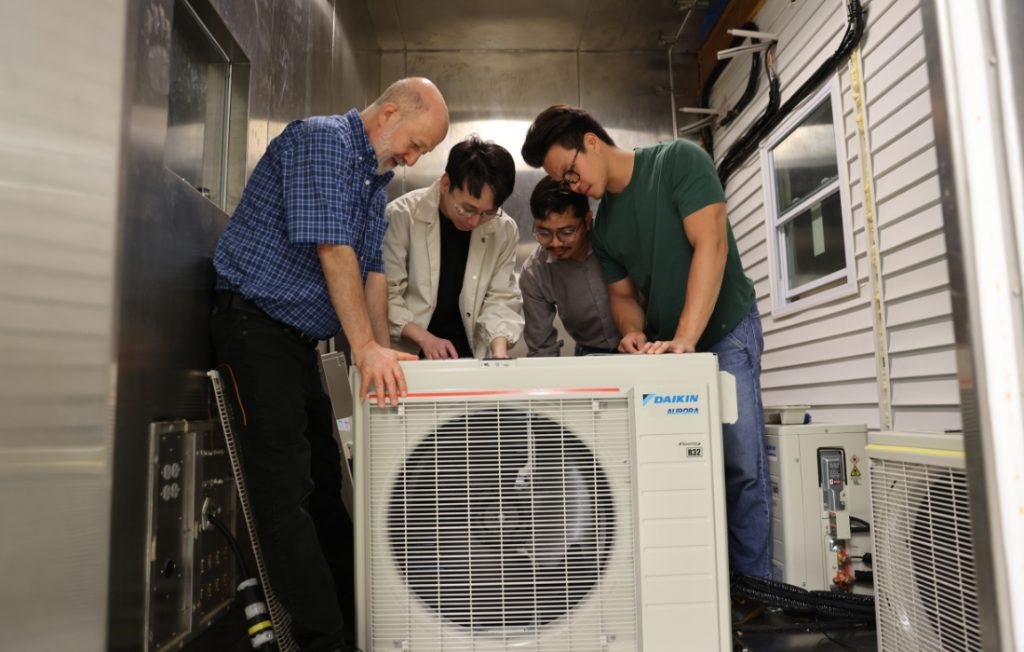
Shapiro is also working with manufacturers like Daikin to put high-efficiency heat pump units through rigorous field testing in Central New York’s cold-climate conditions. Much of this work is led by Pouria Mahdaviani, a second-year Ph.D. candidate studying mechanical engineering.
Across all his work at ECS, student involvement is a priority for Shapiro. Last summer, Ph.D. student Maheswar Chaudhary and two undergraduates, Kittapas (Pun) Tulananda and Madeline Scott, analyzed the performance of typical outdoor heat pump units. They found that air can often bypass the heat exchanger, reducing the unit’s efficiency. The students identified multiple bypass locations on units from major manufacturers and learned how to visualize and quantify bypass airflow. This year, the same team of students will continue working with Shapiro, utilizing the Building Energy and Environmental Systems Laboratory in Link Hall.
A Career Built on Green Building Technology
Shapiro joined Syracuse University in 2023 as a Professor of Practice in the Department of Mechanical and Aerospace Engineering, bringing with him more than three decades of industry experience. “I cut my teeth at Carrier Corporation in Syracuse—that’s where I learned most of my heat pump fundamentals,” says Shapiro. In 1989, Shapiro founded Taitem Engineering in Ithaca, NY, a full-service consulting engineering firm whose name is an acronym for its founding mission: “Technology As If The Earth Mattered.”
Shapiro quite literally wrote the book on green buildings: he co-authored the textbook Green Building Technology, and published a textbook titled Energy Audits and Improvements for Commercial Buildings. He co-wrote the local energy code for Ithaca, which, as of 2026, requires new buildings to be net-zero and completely free of fossil fuels. In 2016, Shapiro was recognized as the Green Building Advocate of the Year at the New York State Green Building Conference.
A “Living Lab” for Green Buildings
Shapiro’s work is anchored within SyracuseCoE, a nationally recognized research center that connects faculty with industry partners and government agencies to advance clean energy and environmental technology. The center is based at 727 East Washington Street, a LEED Platinum university building that serves as a living lab for testing heat pump equipment and other energy-efficient building technologies.
Shapiro also co-leads the Building Training and Assessment Center (BTAC) alongside mechanical and aerospace engineering professor Jackie Anderson. The BTAC, with support from the Department of Energy, teaches students and professionals to conduct commercial energy audits. With this hands-on training, ECS students learn how to identify building deficiencies, recommend remediation measures, estimate costs, and prepare professional assessment reports.
Finally, Shapiro is committed to making his research accessible to industry professionals. Through a partnership with the New York City-based nonprofit Urban Green Council, Shapiro developed heat pump training courses designed to help building professionals transition from fossil-fuel heating systems to heat pumps. To date, more than 260 individuals have completed these trainings.
Moving forward, Shapiro hopes to continue expanding the team’s field and lab testing capabilities, deepen relationships with manufacturers to translate findings into better products, and grow student opportunities in applied research. He is also keenly focused on the human side of the energy transition: helping homeowners understand how to operate heat pumps effectively, from thermostat settings and filter cleaning to what to do when leaving for vacation.
Ultimately, making heat pumps more efficient will mean lower utility bills and safer HVAC systems. “We get to go out, meet people in their homes, and hear about some of the challenges of this technology,” Shapiro explains. “We know heat pumps are better, but they also take getting used to. We’re taking careful note of the obstacles and trying to find ways around them.”