
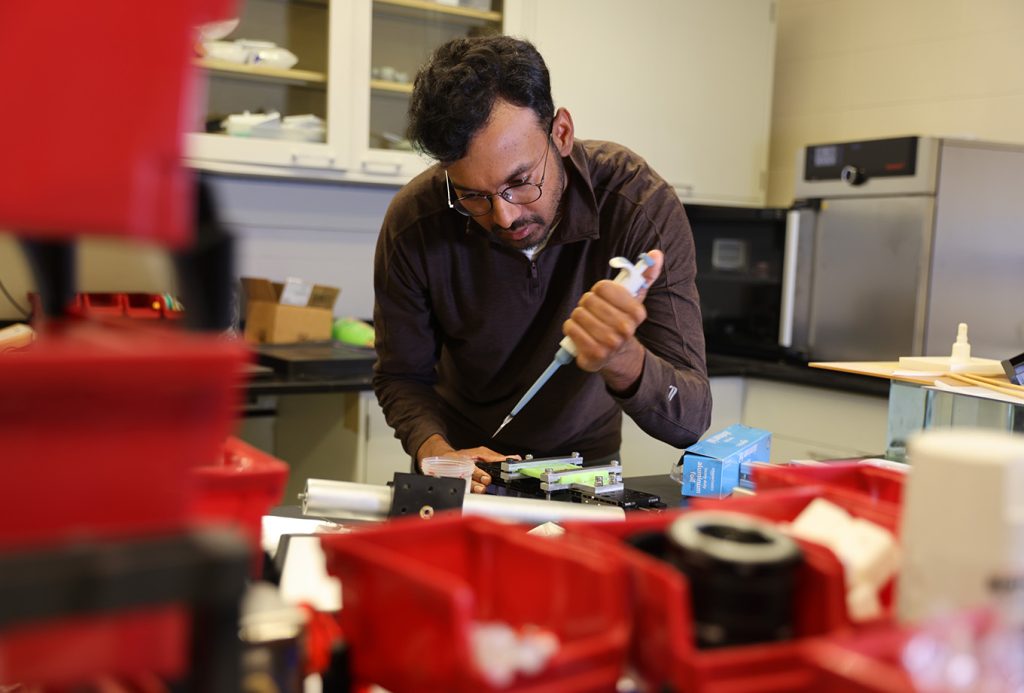
Mechanical and Aerospace Engineering Professor Anupam Pandey’s research team has found that microscopic folds in soft materials can act like tiny, programmable traffic gates for liquid droplets. The folds can stop droplets, let them pass, or merge them together without any surface coatings or additional hardware. Remarkably, the droplets never touch the fold. They sense it from a distance and slow down, stop short, or change course in response. The study was published in the Proceedings of the National Academy of Sciences (PNAS).
The researchers worked with “creases” – narrow, self-contacting downward folds that form when a soft, rubber-like surface is compressed. They found that these creases curve the surface around them, creating an energy barrier a droplet feels from a distance. Droplet smaller than a critical size stop in their tracks before ever touching it, while larger droplets sail right through, creating a sharp threshold.
Adjusting how much the surface is compressed changes the size cutoff, allowing the same crease to be reprogrammed on the fly to block or admit different droplets. This effect is disproportionate: squeezing 15 percent harder quadruples the threshold size.
“What we did not expect is that drops of different sizes are not sensing the same thing,” says Pandey. “The large ones respond to how steep the fold is, the small ones to how quickly that steepness changes.”
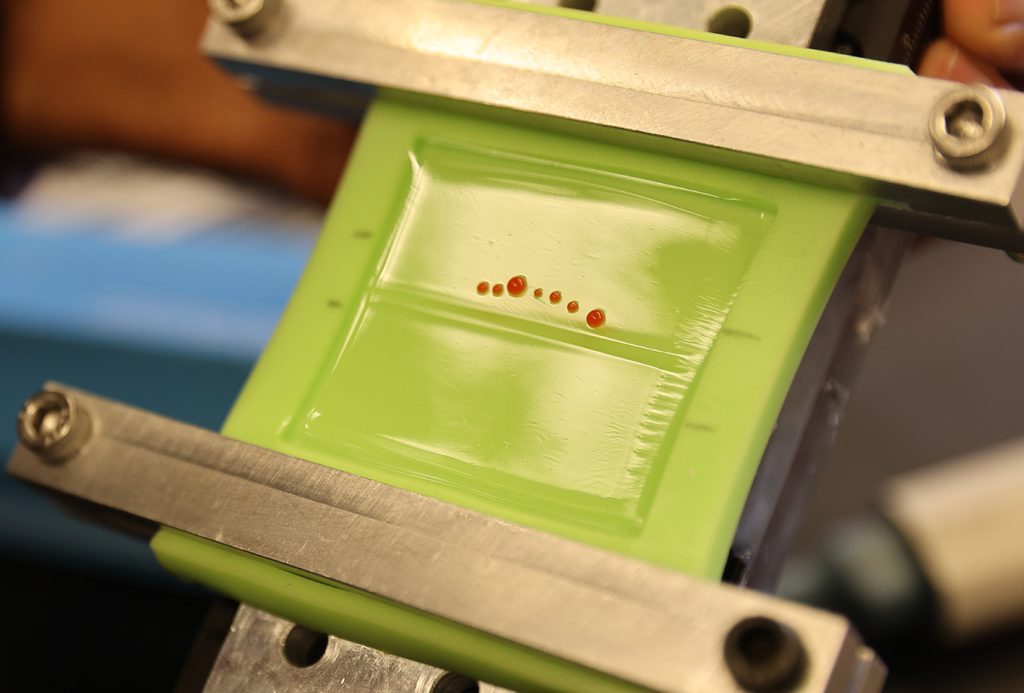
Building on that basic gating effect, the team showed the creases can be arranged to perform more complex tasks: guiding droplets along set paths, sorting them by size or by surface tension, storing a kind of droplet “memory” that keeps track of past inputs, reshaping a stream of droplets into fewer, larger pulses, and even carrying out logic operations similar to those in electronic circuits. In one demonstration, the team routed two streams of droplets into a single crease to build a half adder, the arithmetic unit at the base of every processor. All of these were accomplished using nothing but the mechanical state of the surface itself.
“Because the crease appears and disappears with compression, the circuit is rewritable,” Pandey says. “We can switch a gate off, let everything through, and switch it back on. Nothing is permanently patterned into the surface, and the control comes down to a single mechanical variable.”
Because the surfaces are simple to make and require no batteries, motors or embedded circuitry, the researchers say the approach could be useful for portable diagnostic devices that analyze small samples of fluid and for systems that harvest water from fog or humid air.
Co-authors on the paper, “Creases gate and steer droplets via elastocapillary repulsion,” are Zixuan Wu, a postdoctoral researcher in Pandey’s group; Gavin Linton, an undergraduate in mechanical and aerospace engineering; and Stefan Karpitschka, a professor of physics at the University of Konstanz in Germany.