
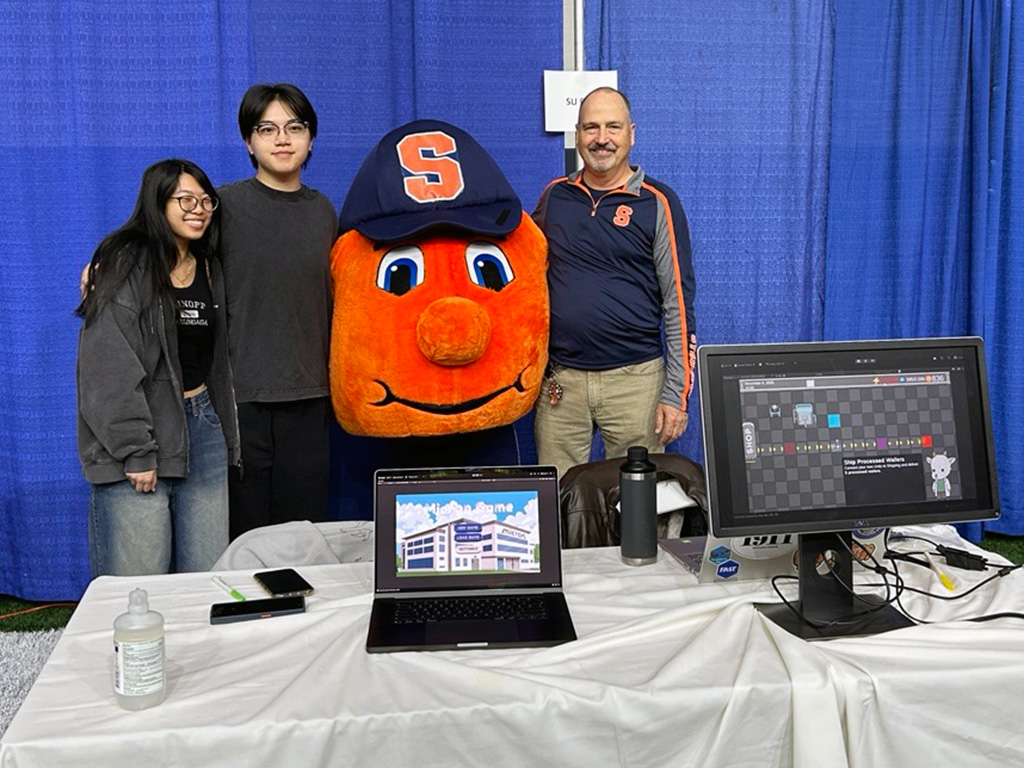
In teaching, experiential learning is the bridge between theory and real-world application, and it’s foundational to all Syracuse University College of Engineering and Computer Science (ECS) programs. When tasked with developing a learning platform, it is no surprise that ECS undergraduates designed an interactive solution. The opportunity came when the electrical engineering and computer science department received a $35,000 gift from Micron to build a tool that teaches K-12 students about manufacturing microchips.
Through an application and interview process, Professor Joseph Waclawski assembled a team of ten students that he describes as “outstanding and self-managed.” The final group included nine computer science students — Alexander Reid ’26 (Project Manager), Alan Tom ’27, Alisha Hassan ’26, Noah Howell ’26, Aicha Gory ’26, Sky-Lailonnie Owens ’28, Jack Keuler ’26, Alex Hartman ’27, and Stephanie Luu ’26 — plus one fine arts major, Leah Bowman ’27, who collaborated on graphic design. Together they gamified microchip production, integrating creativity and technology, to deliver an experience that transforms an abstract lesson into an immersive one. The project had four phases: prototyping, implementation, classroom implementation, and launch.
The team spent multiple semesters meeting with Micron, receiving feedback and access to resources, and researching the complex processes involved in chip fabrication. Reid, Tom, Hassan, Howell, Gory, Owens, and Keuler proposed the initial idea for a tower game because it could account for the many resources that go into making microchips; the same group developed the prototype. Like any video game, the “Micron Game” begins on a main menu — this one featuring an exterior illustration of a Micron facility, where players can start a new game, load an existing game, or change their settings. Upon selecting a new game, players are brought inside to an empty manufacturing floor and are challenged to build a factory, manage resources, and ship chip wafers. A simple and effective design that proved to be intuitive and fun.
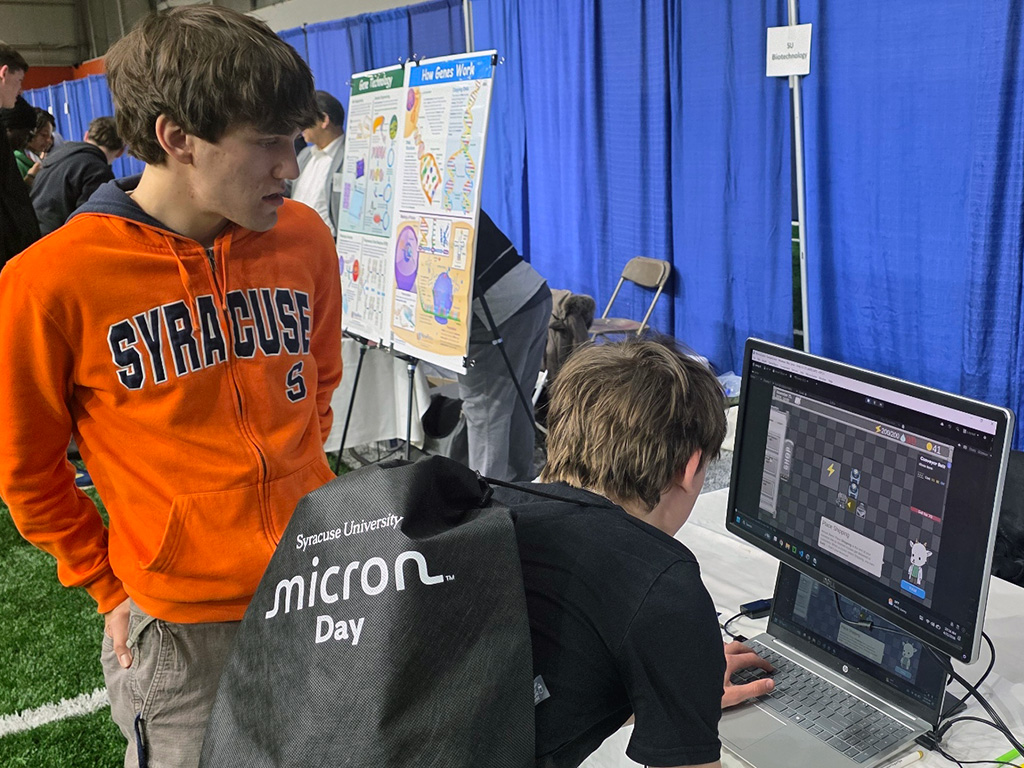
The resulting game was implemented and demonstrated by Tom, Hassan, and Hartman to a very strong reception during Syracuse University’s 2026 Micron Day. Attendees viewed the demo with curiosity and enthusiasm, and as the positive reviews poured in, the team began thinking about next steps for the project. Their initial ideas included stronger tutorials, virtual reality, and richer sound design to make it more engaging and improve user experience.
Beyond chip manufacturing, the game demonstrates commitment to pioneering an outreach project into an undergraduate computer science capstone, and how industry support fosters innovation and amplifies learning — the overarching project has become a prototype itself. Funding experiential learning projects to create new experiential learning opportunities is a novel idea model for philanthropy that connects seamlessly with the hands-on ethos of ECS. Professor Waclawski is currently evaluating remaining funding and working with ECS leadership to determine how to progress the project so the students can continue to level up their game.