Long before Jacob Sardino ’21, G’28 carried the title of staff water engineer, he carried a sketchpad. He was in fifth grade when his elementary school announced an “Improve Your Local Park” design challenge, open to Syracuse City School District students. The assignment: reimagine a neighborhood park a few blocks from his house. Sardino wasn’t, by his own admission, a natural at math or problem-solving but a competitive streak and a promised baseball glove from his dad were enough to get him going.
For the next three weeks, he showed up at the park after school and sketched what he saw, peppering his father with questions each night. What started as a simple drawing became something more considered: a small baseball field tucked into a corner of the park. He won the contest, but says the prize was never really the point. “I enjoyed the feeling of taking an idea, shaping it into a design, and finding a way to continually improve upon that design,” says Sardino. “It was my first glimpse of what engineering could be.”
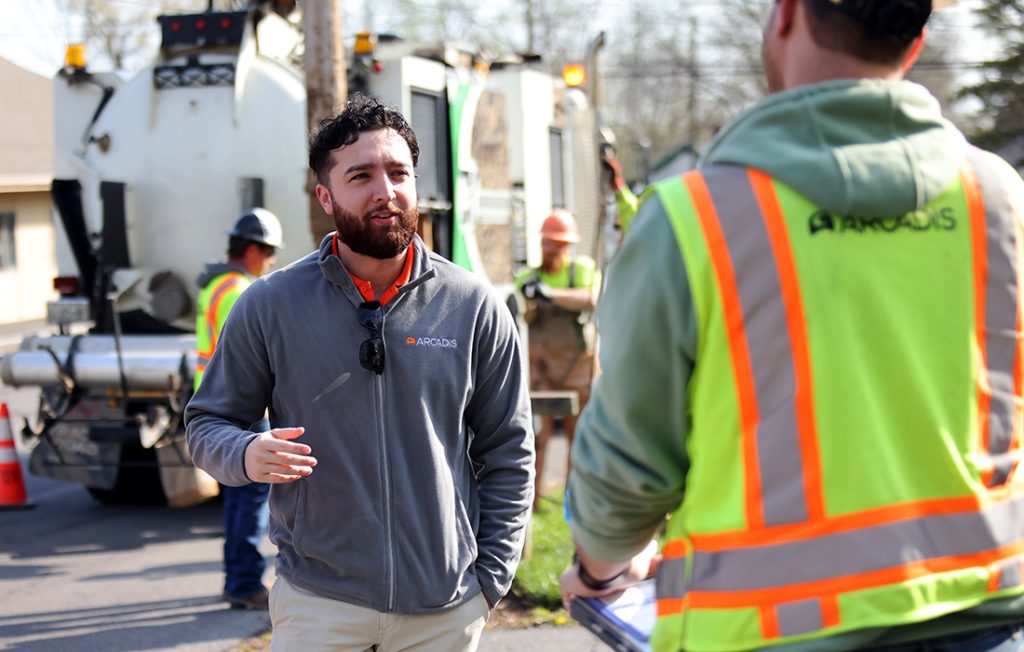
That glimpse turned into a career. Today, Sardino works as a Staff Water Engineer at Arcadis, where he helps plan, design and deliver water and wastewater infrastructure projects that keep communities running for the long haul.
Finding the “Why” Behind the Math
Sardino traces much of his professional outlook back to two professors in the College of Engineering and Computer Science (ECS) at Syracuse University. The first is Civil and Environmental Engineering Professor Svetla Todorova, whose Introduction to Environmental Engineering course reframed how he thought about the discipline. “That class helped me understand that engineering is not just about calculations or technical solutions,” says Sardino. “It is about applying those skills to real-world challenges that affect people, communities and the environment.” Her emphasis on having students think independently rather than just memorizing information made a significant impression on him. When he returned to ECS to work towards his master’s degree while also working full time, she was his first choice as an advisor. “Her influence continues to shape how I approach complex problems in my professional work,” says Sardino.
The second is Civil and Environmental Engineering Department Chair Andria Costello Staniec, who Sardino credits with helping him weather the harder stretches of his undergraduate years. “She was someone who helped me stay grounded, focused and confident that I could work through adversity,” says Sardino. Her support taught him “engineering projects often require patience, adaptability, teamwork, and the ability to keep working toward a solution even when challenges arise.”
Engineering the Infrastructure No One Sees – Until It Fails
At Arcadis, Sardino’s project list reads like a snapshot of the infrastructure that keeps modern life running: large transmission main projects that boost water system capacity and reliability, lead service line inventory and replacement programs that help communities root out aging pipe, and wastewater treatment plant upgrades that keep facilities compliant for decades to come. His day-to-day spans the full arc of a project – engineering calculations, construction plans, and coordination with teams and clients from early planning through construction.
“The decisions we make are not temporary; they shape infrastructure that communities may rely on for decades,” he said. “That makes the stewardship of quality one of the most rewarding and important parts of my job.” A well-designed transmission main or treatment plant upgrade doesn’t announce itself — it just quietly does its job, year after year. “There is a sense of responsibility in that, but also a deep sense of purpose,” he said. “I like the idea that it can quietly support a community every day, protect future generations, and maybe even inspire someone else to see engineering as a way to make a lasting difference.”
Advice for the Next Generation
Ask Sardino whether he would direct a prospective student towards civil and environmental engineering at Syracuse University and the answer comes without hesitation. “I would strongly recommend the College of Engineering and Computer Science to prospective students, especially those who are willing to embrace mentorship and remain open to feedback.” What sets it apart, in his experience, is the accessibility of its faculty, advisors and alumni network. “They are also there to challenge students, guide them through difficult moments, and help them grow into confident problem solvers.”
His advice is straightforward: show up to office hours, ask questions, find mentors, and don’t shy away from criticism. “Engineering school is meant to be challenging,” he said, “but the support system at Syracuse helps students turn those challenges into growth.” It’s a philosophy that traces back, in its own way, to a fifth grader with a sketchpad and a baseball glove on the line -someone who learned early that a good idea is only the beginning.