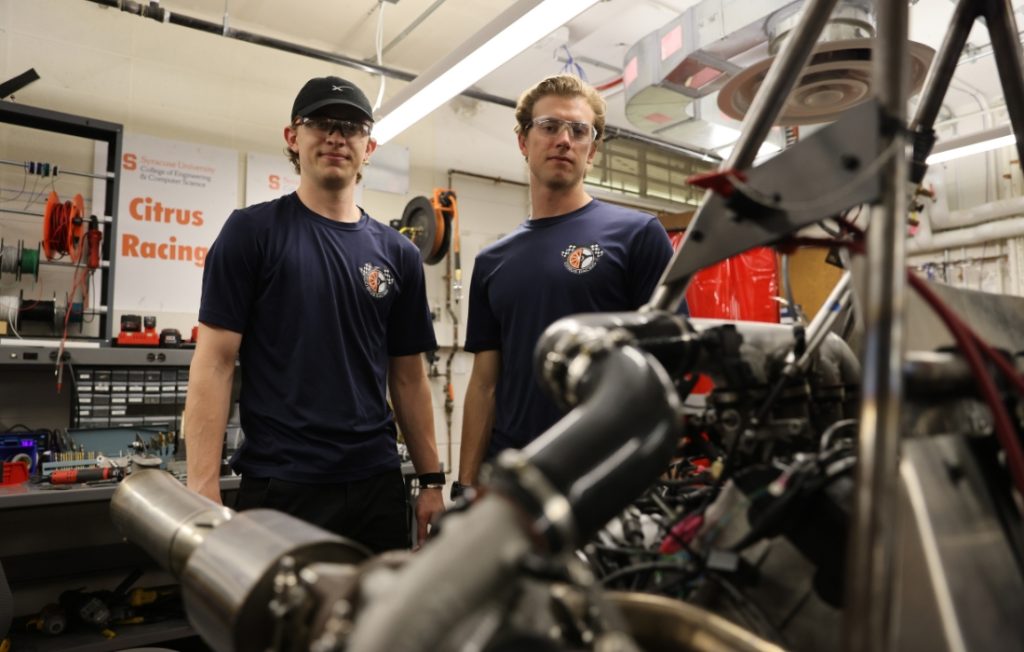
Two Engineering and Computer Science graduates are starting their careers at SpaceX this summer—and their experience with Citrus Racing, Syracuse University’s Formula SAE team, helped them get there.
Ryan Brennan ’26 and Zach Freyman ’26 have both accepted positions with SpaceX, the aerospace company founded by Elon Musk. Brennan, who majored in computer engineering with a minor in electrical engineering, will work in Avionics Electrical Test Engineering at SpaceX’s Hawthorne, California, campus, close to his hometown. Freyman, who studied aerospace engineering, will serve as a Supplier Development Engineer at SpaceX in Texas.
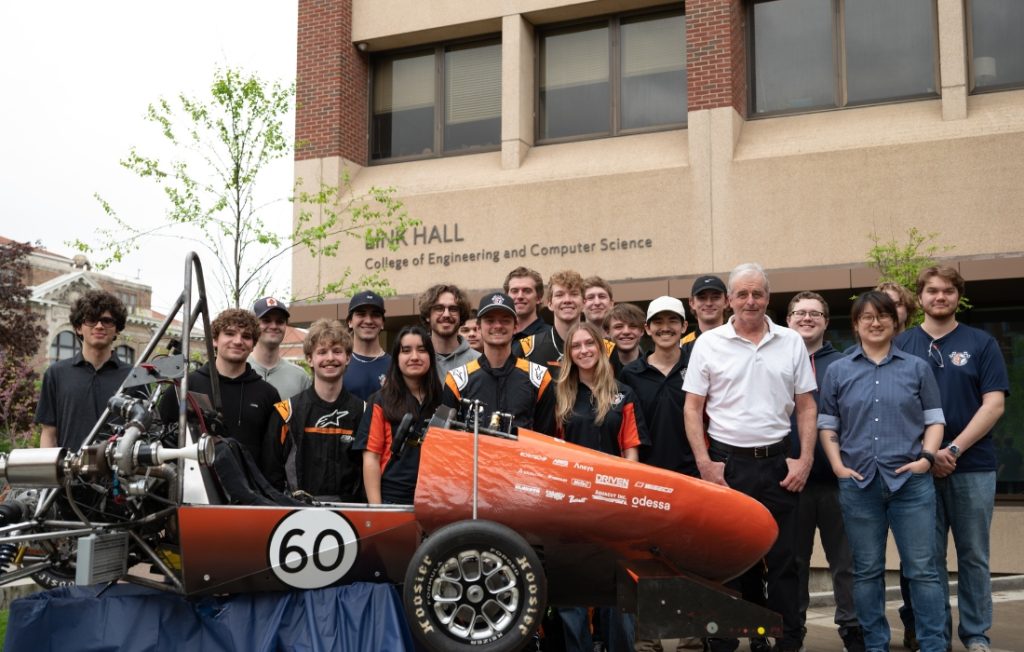
Both Brennan and Freyman are members of Citrus Racing, the University’s fully student-run Formula Society of Automotive Engineers (SAE) team. From their workshop in Link Hall, the team designs and fabricates small-scale formula cars from the ground up. SU’s FSAE team has existed for decades—the first SAE competition was held in 1980—but officially rebranded as Citrus Racing in 2013.
Today, Citrus Racing has a dedicated leadership team composed of undergraduate and graduate students, with support from faculty and staff in the College of Engineering and Computer Science (ECS). Freyman is one of the team’s two Chief Engineers, and Brennan leads the Electrical and Embedded Systems Sub-Team. The interdisciplinary nature of the team makes them stronger, says Brennan: “The electronic systems I build have to work with mechanical systems—if something’s not working, we have to work together to solve it. That’s the type of experience you don’t get in a classroom where everyone has the same major.”
It is no small feat to get a job at such a highly competitive company straight out of undergrad. Brennan and Freyman credit their time with Citrus Racing with giving them an edge over fellow applicants. Citrus Racing team members gain a breadth and depth of technical and operational experience. When Brennan had to give a one-hour technical presentation as part of the SpaceX interview process, he drew from the challenges his team worked on. “It’s like a startup company,” says Brennan. “You’ve got to take full responsibility to make it work or not. That’s a pretty special thing, to have that high-level operational experience coming out of college.”
“As Chief Engineer and Electrical Systems sub-team lead, Freyman and Brennan gained experience in areas that aren’t taught in the classroom: leadership and management of a highly interdisciplinary project,” says Professor Andrea Shen, Citrus Racing’s Automotive Advisor. “Not only did they gain additional knowledge in their own fields, but they also had to come together and work with all the other sub-teams (chassis, aerodynamics, driver systems, suspension, powertrain, business, and media) to make sure all of Citrus Racing ran smoothly and nothing fell behind. To be able to gain this type and amount experience from a student club is phenomenal.”
Brennan notes that hands-on learning in his coursework—from classes in bare-metal microcontroller programming to robotics and digital signal processing control systems—also helped him prepare for his role at SpaceX. “Post-grad, you will never see the same problem twice, and you will repeatedly forget advanced topics,” says Brennan. “Deeply understanding first-principles is the only way to really, permanently, learn—and first-principles intuition can only be accomplished by working on projects and seeing what backfires. ECS faculty like Professors Ehat Ercanli, Jennifer Graham, Jean-Daniel Medjo, and Duane Marcy (now our electrical drivetrain advisor) understand that having significant project-based class material—where students can learn through self-guided failure and revision—is the only way to deeply understand content.”
Brennan, Freyman, and their teammates will be heading to Brooklyn, Michigan, this month for the annual Formula SAE competition at the famed Michigan International Speedway, where over 100 university teams from the United States and beyond will put their cars to the test. In addition to racing their car on the track, each team is evaluated on automotive design, presentation, and business strategy.
While some college FSAE teams must have all their designs vetted or guided by faculty, Citrus Racing is completely student-run. “We are trusted to execute designs responsibly,” explains Brennan. “Dr. Shen actively encourages students on the club to be as operationally independent as possible but is always looking out for us as the same time.”
That freedom to question assumptions and try new ideas ultimately leads to better designs. “This is what SpaceX really values,” says Brennan. “They want engineers who don’t blindly follow design trends. All restrictive guidelines should be brutally questioned and challenged. This mindset produces many failures because it inherently asks for a deviation from the beaten path—but it eventually produces some unique solutions that exceed the general trend.”
“Their time on Citrus Racing adds to what they’ve learned from the coursework in their respective majors, coming together to give both Freyman and Brennan a competitive edge, which helped land them positions at SpaceX,” notes Shen. “I’m very proud of how dedicated these two have been, where they’ve taken this team since joining, and how they’ve set up Citrus Racing to succeed in the future once they go off to SpaceX.”