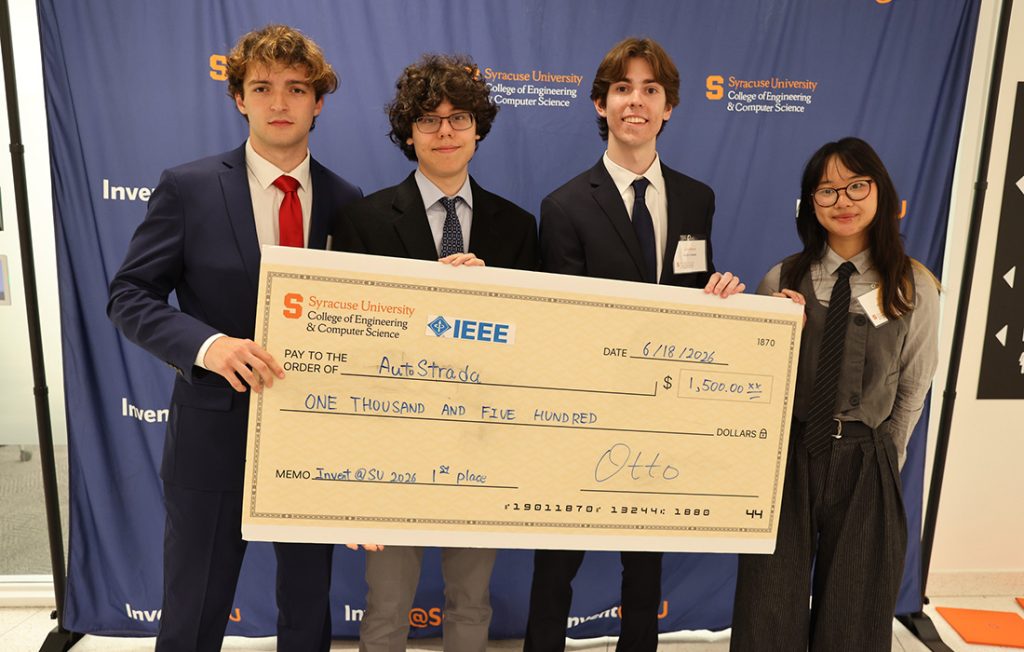
An autonomous traffic control system designed for one-lane construction zones claimed first place at the 2026 Invent@SU final judging, capping a six-week sprint in which eight student teams raced to turn raw ideas into working prototypes.
The winning invention, AutoStrada, earned top honors from competition judges. PawseMat, a smart pet wellness system designed to reduce separation anxiety by rewarding calm behavior, took second place. Tagalong, a wearable bracelet system aimed at improving student safety during field trips and group outings, earned third.
AutoStrada
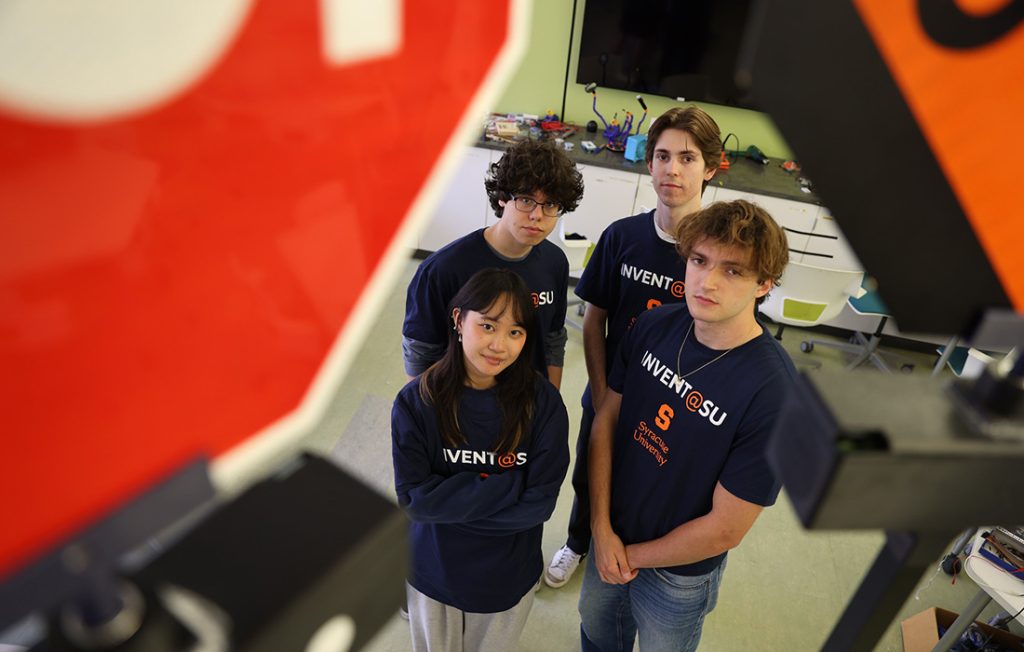
Every year, thousands of construction zones rely on human flaggers to manage the stop-and-go rhythm of single-lane traffic — a job that is both tedious and dangerous. AutoStrada sets out to change that. The system uses autonomous controls to regulate vehicle movement through active construction corridors, removing the need for a stationary worker standing in the path of oncoming traffic.
For the students behind it, the project was as much about personal discovery as engineering innovation.
“I wouldn’t have had this opportunity anywhere else,” said Josh Malvino ’28, a computer engineering student. “It is uniquely Syracuse.”
Mechanical engineering student Jack Barna ’27 credited the program’s open-ended structure with unlocking the team’s productivity. “The freedom to test and develop a prototype was invaluable,” he said. “It let us build a working product in a remarkably short time.”
Electrical engineering student Heidi Ly ’28 said the experience deepened her sense of purpose. “It’s very rewarding — it validates why I love engineering. It’s hands-on, in a great learning environment.”
Computer science student Bleron Balidemaj ’27 pointed to faculty mentorship as a turning point. “The guidance and feedback from the faculty was incredibly helpful,” he said. “It gave us a clear path forward.”
PawseMat
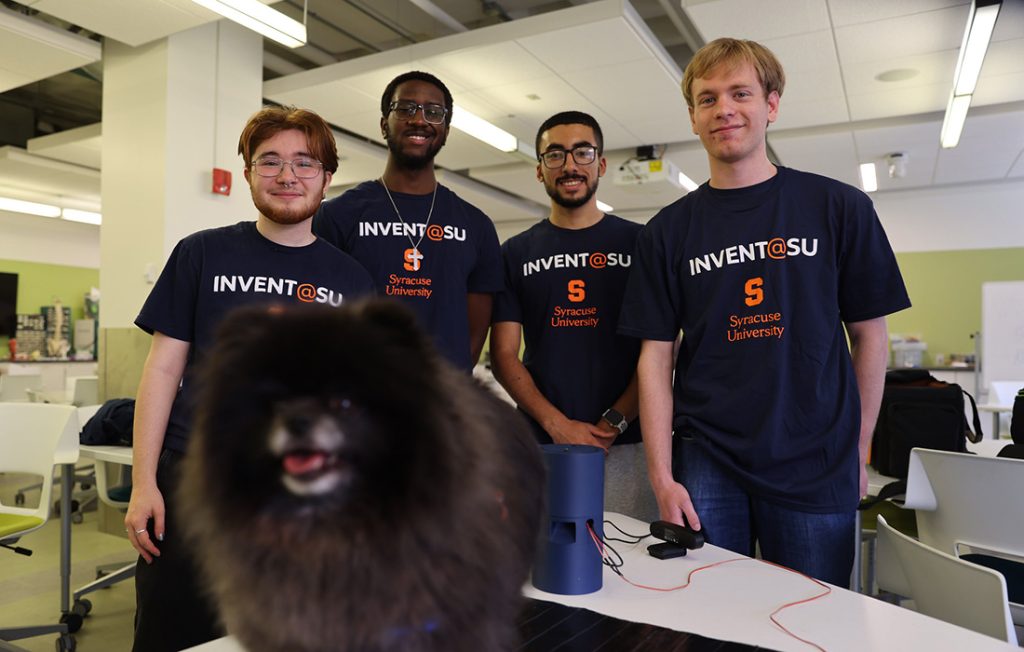
Millions of pets experience distress when left alone — but PawseMat aims to change that dynamic one calm moment at a time. The sensor-equipped mat monitors a pet’s behavior and delivers positive reinforcement when the animal remains settled, turning good behavior into a habit.
For the team behind it, the project was a bridge between classroom theory and entrepreneurial ambition.
“In this program I could apply the engineering concepts I’ve been learning — and now I can see how it could help me start my own company,” said electrical engineering student Ahmad Alawaad ’28.
Biomedical engineering student Leonardo Diehl ’28 highlighted the hands-on dimension as the program’s defining strength. “The testing and hands-on experience is really valuable,” he said.
Mechanical engineering student Aaron BenDaniel ’29 agreed. “This is real, practical experience — and that’s so important.”
For computer engineering student Brandon Isabell ’28, collaborating across disciplines fundamentally changed the way he thinks. “Working with people from different fields completely revamps your problem-solving process,” he said. “The way I approach challenges will never be quite the same.”
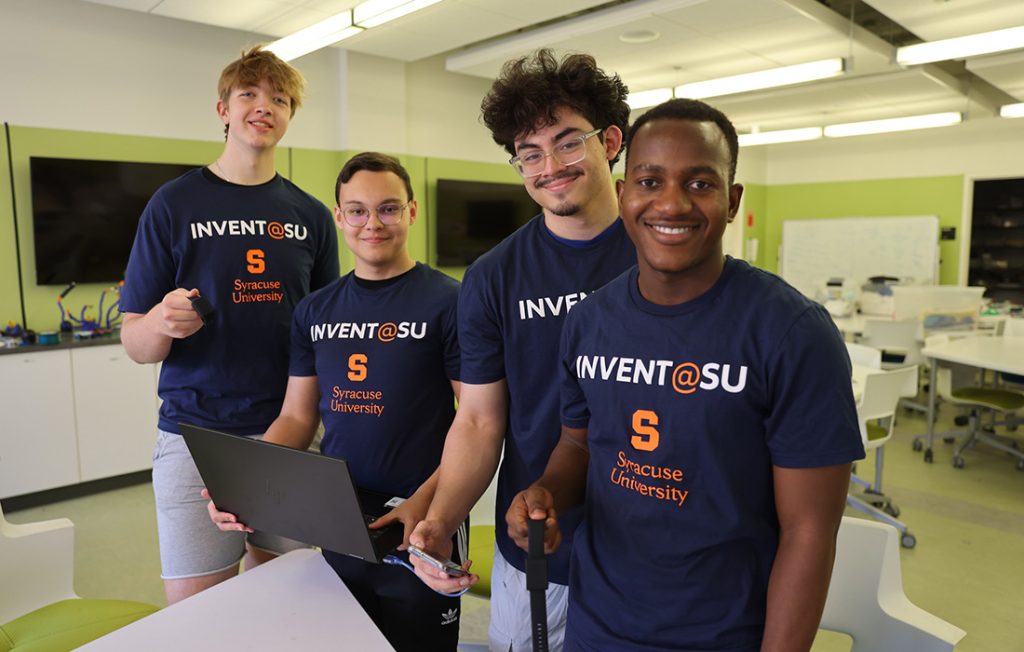
Tagalong
Field trips are some of the most memorable moments in a student’s education — and some of the most logistically stressful for the adults responsible for keeping everyone together.
Tagalong addresses that tension with a networked wearable bracelet that gives chaperones and educators real-time location awareness, helping ensure no student slips away unnoticed.
Chemical engineering student Joseangel Montoya-Contreras ’28 said Invent@SU created rare space for genuine experimentation. “It gives you the freedom to explore your ideas,” he said. “You can actually experiment, not just theorize.”
Mechanical engineering student Humphrey Chinondo ’28 said the team has no intention of stopping here. “We plan to move forward,” he said. “Every great idea came from somewhere small.”
Computer science student Jhon Kiselev ’29 said the team’s interdisciplinary composition was essential to everything they achieved. “By combining our skills, we could accomplish so much more than any of us could have done individually.”
All eight teams received positive feedback from the judges and several plan to continue development of their inventions while working with the Couri Business hatchery, the Blackstone Lauchpad and the Innovation Law Center.
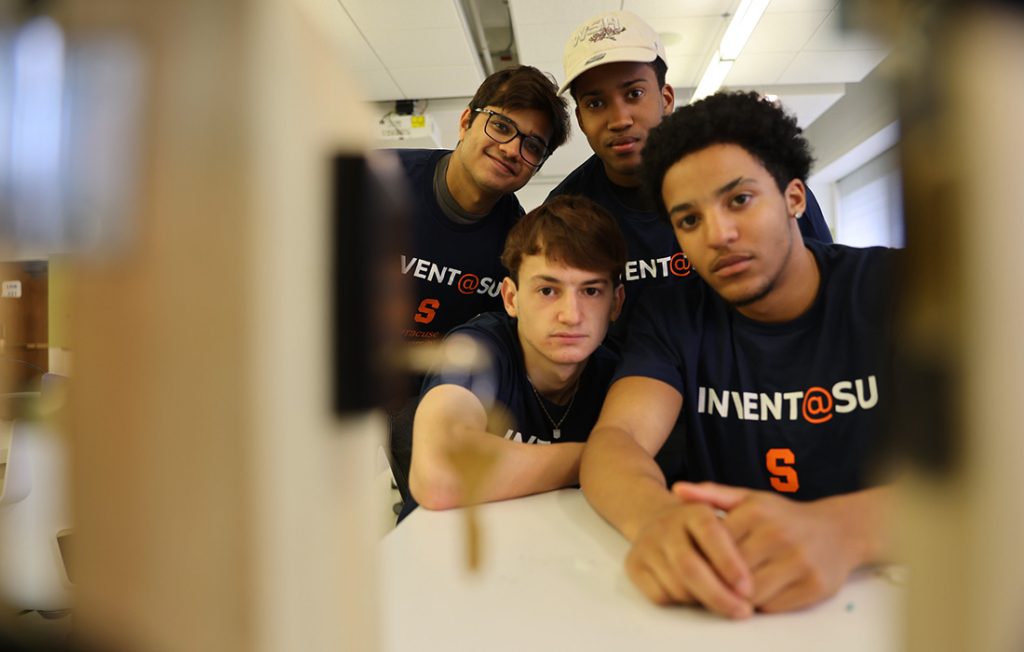
MoniDoor is a renter-friendly smart monitoring system that lets users check their door and lock status from their phone. Designed for apartments and dorms, it installs without modifying existing locks, providing added security and peace of mind.
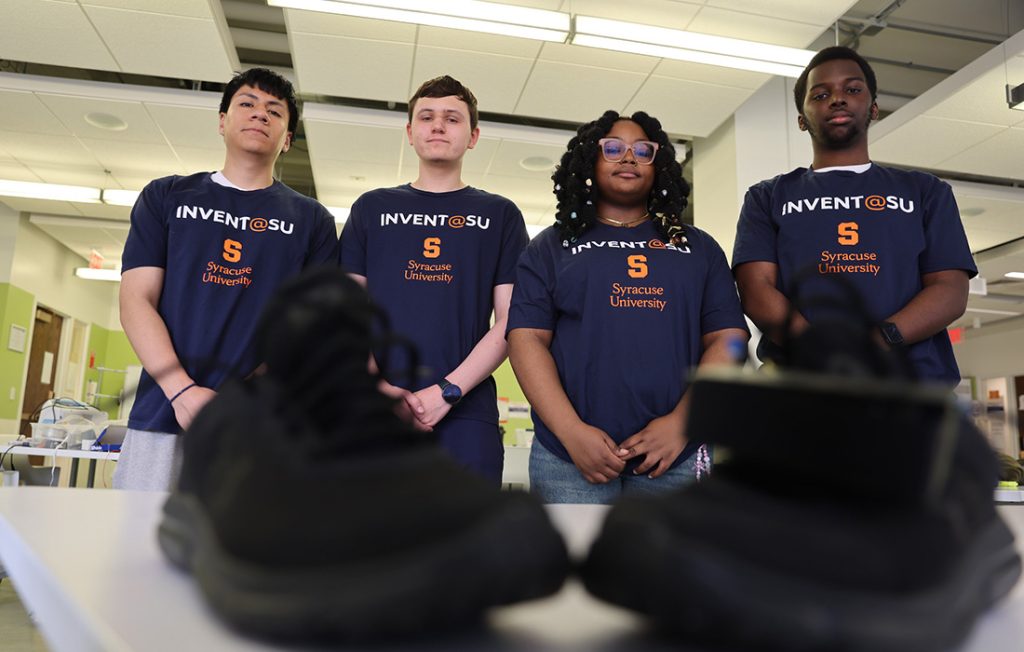
LinkSole is a smart orthopedic insole for people with flat feet that combines arch support with real-time haptic feedback. It helps users improve foot alignment, reduce discomfort, and develop healthier walking habits.
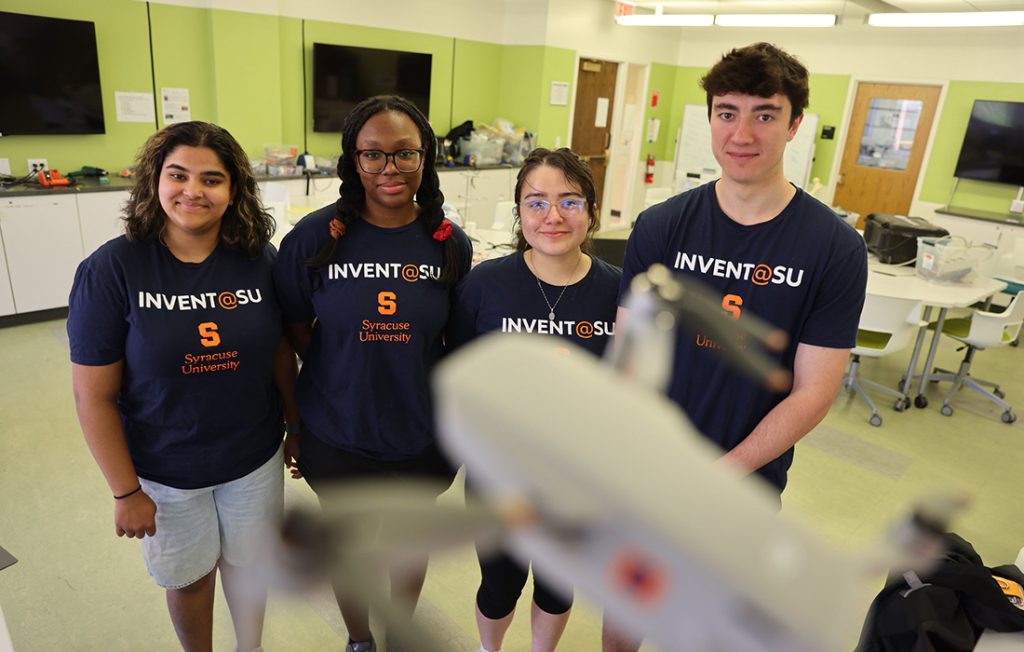
Sweep is an AI-powered litter detection system that uses drones, computer vision, and GPS mapping to identify litter hotspots. It helps organizations target cleanup efforts more efficiently and effectively.
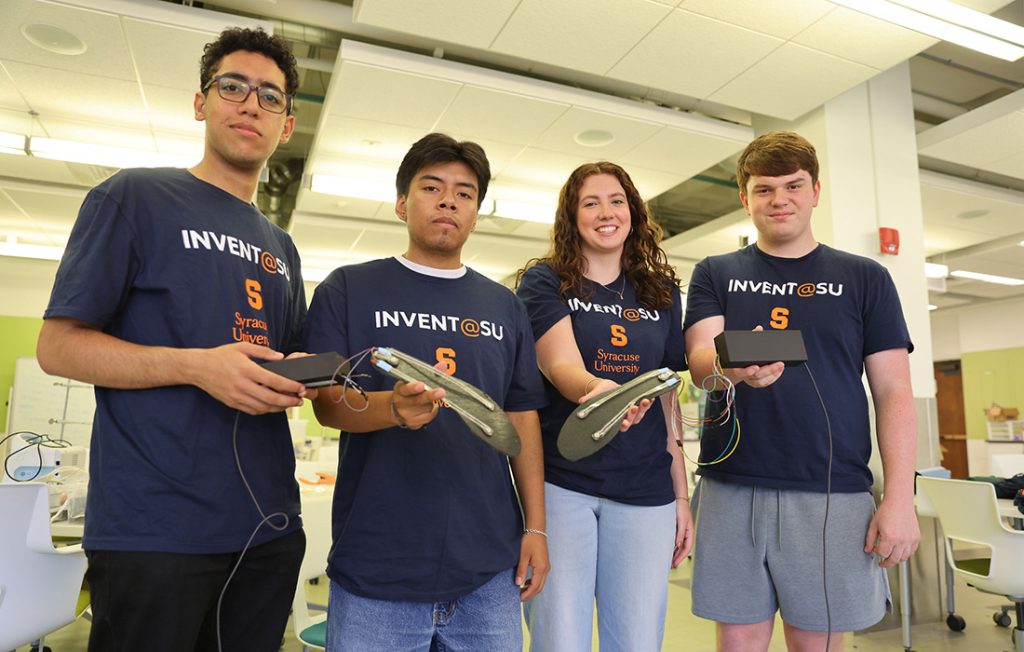
ACL MAXX is a smart insole system that helps athletes recovering from ACL injuries monitor force symmetry between legs. It provides real-time feedback and tracks rehabilitation progress through a mobile app.
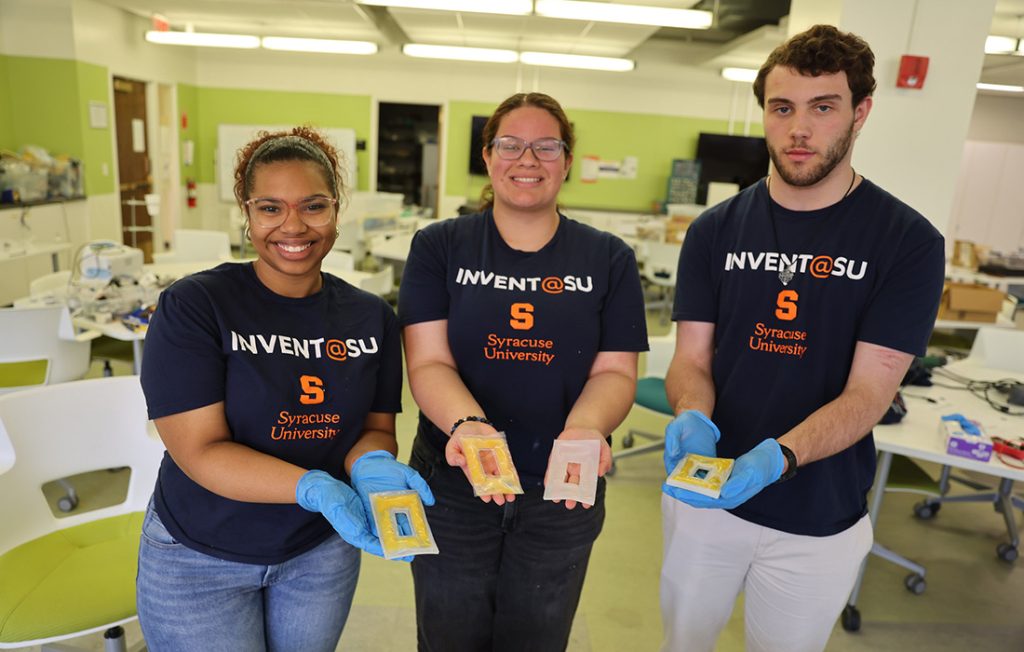
VeinWarm is a medical warming device that improves vein visibility before blood draws and IV placements. Its hands-free heating patch helps reduce needle insertion attempts, improving patient comfort and clinical efficiency.
Invent@SU is made possible through the generosity of alumni and industry sponsors, including Michael Lazar, the Lyons Family Foundation, Mike and Kim Venutolo, and Rajive Dhar and Anita Chowdhry. IEEE Entrepreneurship sponsored the prizes for the 2026 competition. Bill and Penny Allyn have supported the program across multiple years since its founding in 2017.