
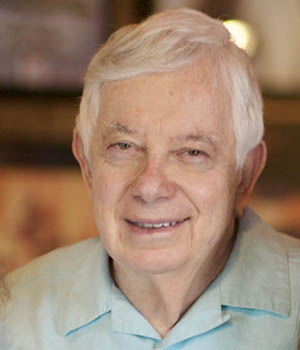
There are engineers who build things, and there are engineers who build engineers. James A. (Jim) Mandel did both – spending four decades shaping the skylines of bridges and the minds of students at Syracuse University, leaving behind a legacy measured not only in tangible physical terms, but in the careers and successes of every student he mentored.
Mandel’s academic path reflected the depth of his commitment to the engineering profession. He enrolled at the Carnegie Institute of Technology, the storied Pittsburgh institution that would later become Carnegie Mellon University, and earned his Bachelor of Science in Civil Engineering in 1956. Between his junior and senior years, he put that education to work as a summer employee for the Bureau of Ships in Washington, D.C., gaining his first taste of large-scale structural work.
After graduation he returned to Carnegie for graduate study, earning his Master of Science in Civil Engineering in 1962. His doctoral work brought him north to Syracuse University, where he earned his Ph.D. in Civil Engineering in 1967 under the tutorage of Professor Paul Brennan, another very well-respected faculty member in the department.
Before becoming a professor at Syracuse University, Mandel was a practicing engineer of considerable range. From 1956 to 1961, with a brief interruption for six months of Army service, he worked for Richardson, Gordon, and Associates, where he designed continuous steel girder bridges, concrete arch bridges, concrete culverts, and railroad bridges across Pennsylvania and beyond.
Then came the most remarkable chapter of his pre-academic career: from 1962 to 1964, he joined Goodyear Aerospace Corporation in Akron, Ohio, where he was placed in charge of the structural design and wind tunnel testing of the Gemini Ballute – an inflatable drag device intended to slow a spacecraft’s re-entry into the atmosphere. The Ballute (a portmanteau of balloon and parachute) was a bold piece of aerospace engineering, and Mandel’s work on it placed him at the intersection of civil, structural, and space-age engineering at one of the most thrilling moments in American history.
In 1967, Mandel joined the faculty of Syracuse University’s Department of Civil and Environmental Engineering (CEE). He would remain there for 41 years, retiring in 2008 as a full professor – one of the longest tenures in the department’s history.
His teaching centered on structural analysis, with a particular passion for finite element analysis (FEA), a computational method for modeling how structures respond to forces, heat, vibration, and other physical conditions. In an era when FEA was transitioning from a niche academic tool to an indispensable industrial method, Mandel was among its most dedicated pedagogues.
His courses were known for their rigor and their real-world grounding. He did not merely teach students to run software – he taught them how engineers think: how to use deductive reasoning, how to write engineering reports, and how to maintain proper scale and judgment when solving real-life engineering problems. His examples were drawn from personal experience: bridges he had designed, structures he had analyzed, and problems he had solved – including, to his students’ fascination, the aerodynamics of spacecraft re-entry.
His research applications were remarkably diverse: elasticity, fracture mechanics, thin shell structures, reinforced concrete, fiber-reinforced concrete, structural dynamics, structural stability, design of water and sludge digester tanks, seismic behavior of nuclear reactor containment structures, and even the computational registration of MRI and PET scans of breast cancer patients – a late-career contribution that revealed a scientist who never stopped seeking new problems to solve.
He married Rita J. Mandel in 1959. They had two children, Belinda and Bob, and five grandchildren. Rita passed away from breast cancer in 1991 – a loss that, by those who knew him, deepened Mandel’s interest in medical applications of computational engineering.
On June 26, 1998, He married Carolyn Lisi, who became a beloved figure in the department community. The Mandels were not just colleagues; they were family to generations of students. To show their love and care, they often invited students into their home to enjoy home-cooked meals. They not only provided these students with good nutrition, but helped sooth their homesickness.
Jim remained engaged with the university as an Emeritus Professor, lending a hand to incoming doctoral students who were finding their footing. He also channeled his decades of experience into new formats. In 2022, he published an Online Finite Element Analysis Course through iUniverse – a comprehensive text bringing his signature approach to FEA to a wider audience, complete with video lectures, worked examples from his career, and applications ranging from structural engineering to breast cancer imaging. In 2025, he published another book titled Finite Element Analysis Course through Outskirts Press, which lays out the history, basic principles, and theory of finite element analysis, and includes more advanced topics in FEA.
In 2024, he published his autobiography: The Life of JAM: The Story of My Life — a personal account spanning his childhood in Pittsburgh, his work in the civil and aerospace fields, his family, friends, students, his years at Syracuse, and all the memorable moments between. It is, in its own way, the testament of an engineer who understood that a life well-examined is as worth building as any bridge.
The most visible sign of Mandel’s impact on Syracuse University is the establishment of several departmental awards by his former students. For instance, the Dr. James A. Mandel Prize for Achievement in Civil and Environmental Engineering was set up by five of his former African-American students to honor a graduating CEE student who is an active member of the National Society of Black Engineers (NSBE); the Dr. James A. Mandel Award, established and funded by another CEE alumus Mr. Abdallah Yabroudi, is awarded annually to three outstanding juniors in the department. These awards are recognitions given in his honor not to a researcher or an administrator, but to students — a fitting tribute for a man who spent four decades believing that teaching was the highest form of engineering.
Those who knew Mandel describe a professor of uncommon patience, genuine curiosity, and an open-door policy that meant what it said. He was not a professor who kept office hours – he kept a life in the department, where students, colleagues, and doctoral candidates were always welcome.
“He was one of a kind,” says Abdallah H. Yabroudi ’78, G’79, chief executive officer of Dubai Contracting Co. and Syracuse University Life Trustee. “Simple, loving and a person who dedicated his life to engineering teaching and education till his last day. I looked at him as my adviser, professor, mentor, friend, a loving person, and a father. His memory will remain living in my heart and may God almighty rest his soul in peace. Goodbye my dear friend.”
“The engineer that I am today is because I had Dr. Mandel as a professor,” says Priscilla Tyree Williams ‘86, construction projects administrator for the City of Raleigh and member of the Engineering and Computer Science Dean’s Leadership Council. “He poured into me and always encouraged me. He believed in me and that made me believe in myself. And, for that, I am eternally grateful. His legacy lives on in each student he taught and mentored.”
Civil and Environmental Engineering Professor Eric Lui, a longtime colleague and a good friend of Mandel describes him as “a person with a mind of an intellectual, a heart of gold, a body full of energy, a temperament of gregariousness, and a vision of virtue”. Lui further stated that “Jim sees goodness in each and every person, and he brings the best out of everyone he crossed path with.”
“I was fortunate to have Jim Mandel as a colleague in the CEE department when I joined Syracuse University, and throughout the first three decades of my career,” says Professor Emeritus Shobha Bhatia. “I remain deeply grateful for the mentorship, friendship, and genuine care he extended to me and my family. I was especially honored and touched by his thoughtfulness in dedicating a chapter to my family in his book, The Life of JAM: The Story of My Life. Jim was one of the rare individuals who truly cared about his students, staff, and colleagues, and who consistently went out of his way to support others. He will be remembered not only for his generosity of spirit, but also for his warmth, his sense of humor, and his distinctive way of telling jokes—often with a quiet smirk on his face.”
“Jim Mandel was a wonderful member of the CEE faculty for so many years,” said Professor Emeritus Samuel Clemence. “I remember when I joined the faculty in 1977 Jim was very gracious and kind to me and offered to help me at the beginning of my tenure. Over the years we shared lots of good times working on research projects, joint consulting activities and teaching students. Jim truly loved teaching and advising our students. His office door was always open to help any student in need. Jim also had a great sense of humor and was always ready to share a joke or an amusing reminiscence—we all truly miss his presence.”
He was the kind of engineer who saw, in every structure – every beam, every bridge, every equation — not just a problem to be solved, but a chance to do something that would outlast him.