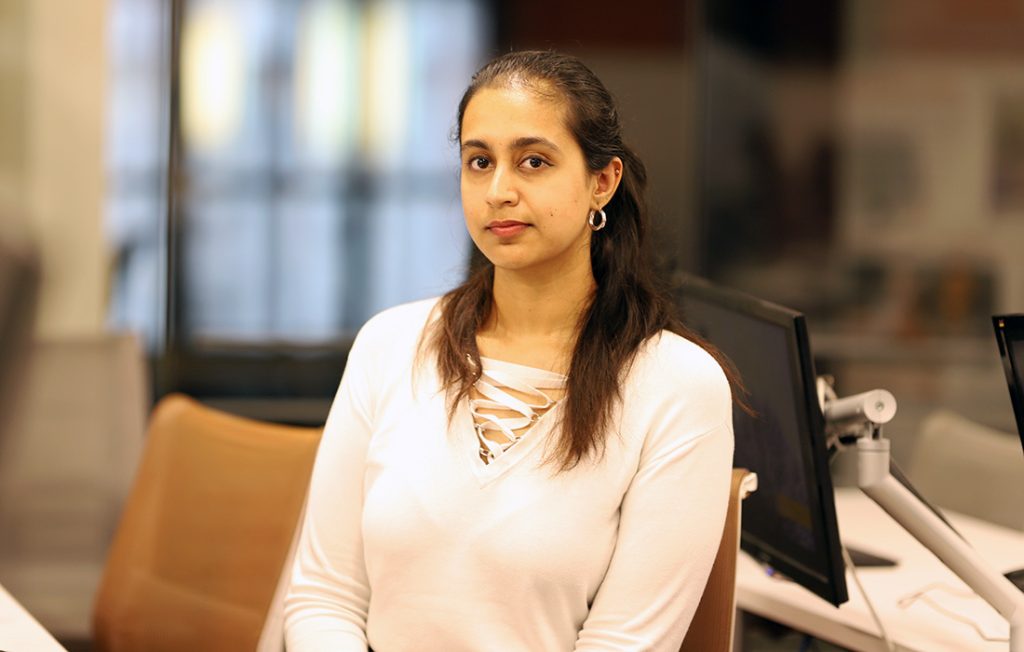
Eager to expand her knowledge as a software engineer, Kamaljit Kaur Aulakh G’25 enrolled in the College of Engineering and Computer Science (ECS) to pursue a master’s degree in computer science. During her time at ECS, she secured internships as a backend developer with prominent fashion brands and found opportunities at Syracuse University’s Open Source Program Office (OSPO) through its co-op program. In the following Q&A, Kaur discusses her academic journey and the importance of computer science.
Tell us about yourself!
Before starting my master’s at Syracuse University, I was working back in India with different banks and financial systems as a software engineer and was building systems. At some point, I wanted to learn new things like security and cloud computing, so I decided to pursue my master’s degree.
The first year was really hectic because we were focusing on completing our code courses, and we had two major courses with which were operating systems and algorithms. After my first year, I worked as an intern for Versace, Jimmy Choo, and Michael Kors for the backend team during the summer. Returning to campus, I was lucky enough to find an opportunity at the Open Source Program Office (OSPO) as a web developer.
What made you choose the computer science master’s program at Syracuse University?
I heard great things from students about ECS, who told me about TAs and professors specifically, Sucheta Soundarajan and Endadul Hoque, who were renowned for their research. I’m not a research student, but it was a privilege to study under them.
Syracuse University is also quite accommodating to international students. They offered generous scholarships, and that was a factor in why I decided to enroll.
What is the importance of computer science education in today’s world?
Computer science can be integrated into every field these days. There are opportunities where it gets integrated in a company like Michael Kors, which is a fashion brand. This is my motivation for pursuing a career in this field since there is a lot of potential.
How was your experience working at OSPO?
My role involved supporting research at the University. One project I did was a data storage finder, which helps researchers find what kind of storage they should opt for based on the requirements. They can also have faculty send feedback on how they can make improvements to it.
Another tool I’ve built is QDR, a qualitative data storage repository. It’s hosted by Maxwell and is famous among other universities as well. I created a data pipeline that can pull data from one source and ingest it into another. This has great potential because it’s open source, so students and other universities can use their code as a base reference point.
How did OSPO’s co-op program help you as a student?
The co-op program was a big help. As an on-campus full-time student, companies don’t usually hire full-time students. OSPO’s co-op program allowed me to work on campus as a full-time student in a technical way, complementing my background and experience.
What are your future career plans?
I’d like to move towards senior software development and a mix of cybersecurity or blockchain, or something that integrates both system development and improvement.