

Electrical Engineering and Computer Science Professor Ethan Arnault has received a National Science Foundation (NSF) award to help solve one of the biggest problems standing in the way of building bigger, more powerful quantum computers.
The award comes from the NSF's Electrical, Communications and Computing Systems division. It will fund research into small devices, built directly onto computer chips, that could help quantum computers grow larger without overheating.
Quantum computers that use superconducting circuits are seen as one of the most promising ways to solve problems that are too complex for today's regular computers. They could eventually help with things like designing new materials, discovering drugs, securing communications and strengthening national security. But there's a catch: every time engineers add another qubit, the basic unit of information in a quantum computer, they also need to add more microwave cables to control it and read its data. Those cables let heat leak into the extremely cold environment qubits need in order to work. As quantum processors get bigger, that heat buildup makes it harder to keep improving them.
One possible fix is to place the control and measurement electronics right on the same chip as the qubits, instead of connecting them through bulky external cables. This approach is called "cold control." The problem is that current chip-based devices aren't precise enough to make this practical yet.
Arnault's research aims to fix that by designing a new type of compact device based on what are called multi-terminal Josephson circuits. These rely on unusual behavior found in superconducting materials, letting them act as extremely sensitive detectors and also as clean, low-noise sources of microwave signals.
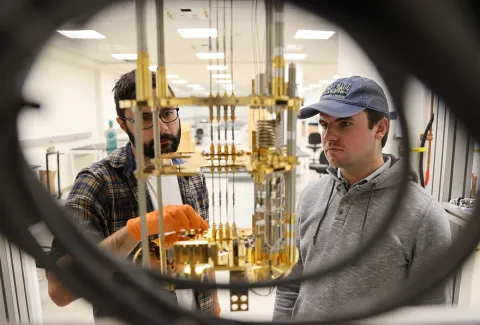
“The underlying physics of multiterminal Josephson circuits has been well worked through by the device physics community," says Arnault. "What we’re doing here is trying to translate those results into real applications.”
This could remove a major roadblock to building larger superconducting quantum computers and help keep the United States at the forefront of quantum information science. The same devices could also be useful elsewhere, working as highly sensitive sensors and amplifiers for studying new materials or managing heat in other supercooled systems.
On a technical level, the project addresses shortcomings in two existing cold control methods. One method, which uses devices called DC-biased Josephson emitters, produces signals that aren't precise enough. Another, based on devices called nanobolometers, are too slow for qubit readout, which reduces accuracy. Arnault's devices are designed to overcome both issues by taking advantage of richer, more flexible signal behavior available in multi-terminal Josephson circuits, something not possible with the simpler two-terminal versions used today.
The project has two main parts. The first focuses on building devices called Josephson parametric amplifier bolometers, which combine a sensor with a signal booster. Researchers will fine-tune these devices using electrical current and voltage controls on a graphene-based component, aiming to detect single microwave photons in the 4 to 8 gigahertz range, the frequencies commonly used by qubits, and to reset almost instantly, within billionths of a second.
The second part studies a different phenomenon: coordinated microwave signals produced by groups of electrons moving together in specific patterns. Researchers want to find out whether this natural coordination can produce unusually clean, low-noise signals. Longer term, the team hopes to combine both devices to measure power entirely on the chip itself, without any outside equipment.
“We’re tackling two sides of the problem," says Arnault. "What devices can create low-noise microwave signals that could control qubits? On the other hand, what devices can measure those qubits as efficiently as possible?”
Beyond the technical work, the award also supports training the next generation of scientists in this field. It will fund a graduate student and a postdoctoral researcher, give undergraduate and high school students hands-on research experience and provide data for new quantum engineering courses at Syracuse University.