

Mechanical and Aerospace Engineering Research Team Works With NASA to Turn the Moon’s Soil into Building Materials
Researchers in the Department of Mechanical and Aerospace Engineering have developed a composite made from simulated lunar soil that cures at ambient conditions, offering a low-energy path to building habitats, landing pads and other structures on the Moon.
The work is led by Professor Yeqing Wang and Andrea Hoe, a graduate student researcher. The project is supported by NASA and conducted in collaboration with researchers at NASA’s Marshall Space Flight Center in Alabama.
The approach uses the Moon’s abundant native soil, known as regolith, as the primary structural material. That minimizes the amount of material that must be launched from Earth and could support robotic construction for NASA’s Artemis missions.
Small amounts of graphite nanoplatelets, added at low weight percentages, enhance the composite’s strength and durability. The nanoplatelets are tiny carbon-based sheets. The team also applied a surface treatment to improve the bond between the graphite and the surrounding material.
The composites reach compressive strengths approaching 40 megapascals, the level required for building structures on the Moon. After simulated thermal cycling, they retained about 92% of their original strength, suggesting the material can maintain its structural performance through the Moon’s extreme temperature swings.
“Ultimately, we hope to develop durable, low-energy and potentially 3D-printable materials for lunar habitats, landing pads and other infrastructure,” said Wang.
The material can be made with relatively low compaction pressure and cured at ambient conditions. That eliminates the energy-intensive high-temperature processing, such as sintering or melting, typically required for regolith-based construction.
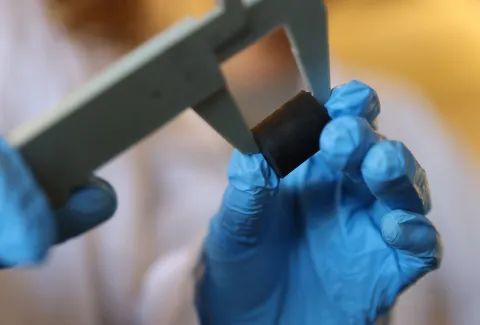
The new work builds on earlier research by the team, published in the journal Small. That study examined carbon nanotubes as reinforcements for lunar regolith composites under simulated lunar temperature conditions. The nanotubes improved mechanical strength, but the researchers found that a mismatch in thermal expansion could reduce long-term durability during extreme temperature cycling. That finding led them to graphite nanoplatelets, which are more thermally compatible with the regolith-based matrix.
“Working with NASA has been a truly life-changing experience,” said Hoe. “I’ve had the opportunity to collaborate with people from diverse backgrounds and areas of expertise, contribute to exciting and meaningful projects, and learn from a community that has been incredibly welcoming and supportive.”
Wang says the approach provides a foundation for future industry partnerships and technology development in New York.
"This approach uses the Moon’s own regolith and avoids energy-intensive sintering and high-pressure processing, so NASA can launch less material and spend less power building on the surface," said Wang.